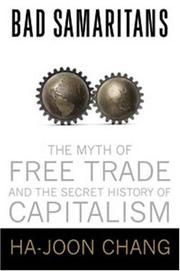
Bad Samaritans
The case that rich countries prescribe policies they never followed.
Summary
Chang, a Cambridge development economist, argues that the policies rich countries recommend to developing countries are the opposite of the policies those countries used when they were developing.
The historical argument is the foundation and he developed it more fully in Kicking Away the Ladder. Britain protected its industries heavily until it had achieved technological leadership, then advocated free trade. The United States was the most protectionist country in the world through most of the nineteenth century, with tariffs at levels no developing country is now permitted. Japan, Korea and Taiwan used protection, subsidised credit, restrictions on foreign investment and deliberate acquisition of foreign technology. Chang argues that every country that has industrialised did so using policies the current international framework prohibits.
His positive case is for infant industry protection: a domestic industry cannot compete with established foreign producers while it is learning, but with temporary protection and a requirement to become competitive it can. He distinguishes this from permanent protection, which produces the inefficient industries the critics describe, and argues that the difference lies in whether the state imposes performance requirements and withdraws support from failures.
He also attacks specific orthodoxies: that foreign investment is unambiguously beneficial, that privatisation improves performance, that strong intellectual property protection helps development, that corruption and cultural factors explain underdevelopment, and that democracy and markets naturally reinforce each other.
Chang writes accessibly and polemically. The historical evidence on developed countries' own trajectories is strong and widely accepted. The inference that developing countries should therefore adopt those policies is contested, since the international environment differs and since the successful cases had state capacity that most developing countries lack. Critics also argue he selects successful interventions and does not weight the many failures.
Key takeaways 7
- Every country that industrialised used protection, subsidy and technology acquisition policies that current international rules prohibit.
- Britain and the United States advocated free trade only after achieving technological leadership behind high tariffs.
- Infant industry protection works when the state imposes performance requirements and withdraws support from failures, and fails when it does not.
- Foreign direct investment is not unambiguously beneficial, because it can displace domestic firms that would have developed capability.
- Strong intellectual property protection transfers rent to existing technology holders and raises the cost of catching up.
- Corruption and cultural explanations for underdevelopment fail because the same features were present in countries that later developed rapidly.
- The successful cases had state capacity to enforce performance requirements, which most developing countries lack.
Who should read it
Investors and operators in developing markets who want the historical case against the standard policy prescriptions, weighed against the state capacity objection.
Where it sits in the reference 2
Similar books 6
Chosen by shared topics, the entries that hold them, and the people who recommended both.