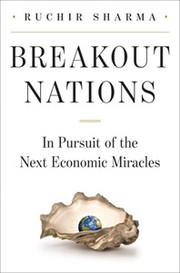
Breakout Nations
Earlier and more country-by-country; useful as a record of which calls aged well.
Summary
Sharma, who ran emerging markets at Morgan Stanley Investment Management, argues that the assumption of continued rapid convergence by emerging economies is wrong, and that the 2003 to 2007 period was an unusual episode driven by a commodity boom and cheap global money rather than a permanent shift.
His method is comparative and empirical rather than theoretical. He argues that very few countries sustain high growth for more than a decade, that the historical base rate for maintaining above-average growth over long periods is low, and that the BRIC grouping was a marketing construct with no analytical content since the four countries share nothing structurally. He works through countries individually, assessing Brazil's high interest rates and low investment rate, Russia's dependence on oil, India's fiscal position and infrastructure, China's investment-heavy growth model and its coming slowdown, and the prospects for Turkey, Indonesia, South Korea, the Czech Republic and others.
His practical indicators are the useful part: watch the share of investment in GDP, the size of the largest companies relative to the economy, whether billionaires are in rent-seeking or productive sectors, whether inflation is being controlled, whether the currency is competitive, and whether the country appears on magazine covers, which he treats as a contrarian signal.
The book is from 2012 and its specific calls can be checked. He was right about the commodity supercycle ending, about Brazil and Russia disappointing, and about the general slowdown in emerging market convergence. He was too pessimistic on India over the following decade. The country-by-country material is dated but the indicators remain usable.
Key takeaways 7
- Very few countries sustain above-average growth for more than a decade, so extrapolating a strong decade is the most common error in emerging market forecasting.
- The 2003 to 2007 emerging market boom was driven by a commodity cycle and cheap global money rather than by structural improvement.
- The BRIC grouping had no analytical content, since the four countries shared no structural characteristic that would produce common outcomes.
- A high and rising investment share of GDP is the most reliable indicator of a country's growth prospects, provided the investment is productive rather than speculative.
- The composition of a country's billionaire list, meaning whether wealth comes from rent-seeking or productive sectors, predicts the durability of its growth.
- When one company or one family dominates a share of national output, the economy has a concentration risk that aggregate statistics conceal.
- Sustained attention from international media and investors is a contrarian signal, because the capital has usually already arrived by the time the story is told.
Who should read it
Emerging market investors who want practical country-level indicators and a corrective to convergence assumptions.
Where it sits in the reference 3
Who recommended it 1 · 1 direct
Similar books 6
Chosen by shared topics, the entries that hold them, and the people who recommended both.