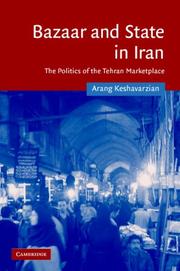
Bazaar and State in Iran: The Politics of the Tehran Marketplace
How informal credit, trust networks and trade finance work when the banking system does not.
Summary
The reference has not verified this book in detail; the summary states only what the title, author and subject establish.
Keshavarzian, a political scientist, studied the Tehran bazaar and its relationship with the state, working from interviews with merchants and from archival research.
His argument challenges the standard account. The conventional view treats the bazaar as a traditional institution whose merchants are religiously conservative, politically oppositional and structurally unchanged, and which supported the 1979 revolution as a natural expression of that character. Keshavarzian argues that the bazaar is not a fixed traditional entity but a network whose structure has been reshaped by state policy in each period.
Under the Pahlavi state, he argues, policies including credit allocation, import licensing and the promotion of alternative distribution channels attempted to marginalise the bazaar, which produced cohesion among merchants and made collective political action possible. That cohesion, rather than any inherent religious conservatism, is what enabled bazaar participation in the revolutionary coalition. Under the Islamic Republic, by contrast, state policies of selective licensing, foundation involvement in trade and the allocation of foreign exchange fragmented the bazaar's networks by creating differentiated access, which reduced its capacity for collective action despite the regime's ideological alignment with it.
The methodological point is that the capacity of an economic group to act politically depends on the structure of its internal networks, and that state policy shapes that structure whether or not it intends to.
The book is academic political economy and assumes some familiarity with Iranian history. The reference has not verified every empirical claim. The general argument, that a commercial community's political capacity depends on network structure rather than on its members' beliefs, has application well beyond Iran.
Key takeaways 7
- The bazaar is a network whose structure has been reshaped by state policy rather than a fixed traditional institution.
- Pahlavi policies that attempted to marginalise the bazaar produced the cohesion that made collective political action possible.
- Bazaar participation in the 1979 revolution followed from network cohesion rather than from inherent religious conservatism.
- Islamic Republic policies fragmented the bazaar's networks by creating differentiated access to licences and foreign exchange.
- A regime ideologically aligned with a commercial group can reduce that group's political capacity more effectively than a hostile one.
- The political capacity of an economic group depends on the structure of its internal networks rather than on its members' beliefs.
- Selective allocation of state-controlled resources is an effective method of fragmenting a commercial community.
Who should read it
Analysts working on Iran or on state-business relations who want a structural account of how policy shapes a commercial community's political capacity.
Where it sits in the reference 2
Similar books 6
Chosen by shared topics, the entries that hold them, and the people who recommended both.