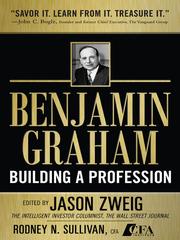
Benjamin Graham, Building a Profession
Edited collection of Graham's own writings and interviews
Summary
Zweig and Sullivan assembled this for the CFA Institute, collecting Graham's writings, lectures, testimony and interviews that appeared in the Financial Analysts Journal and its predecessor, along with material about him.
The collection's organising theme is Graham's role in creating security analysis as a profession. He helped establish the New York Society of Security Analysts, argued for a certification programme that became the Chartered Financial Analyst designation, and wrote repeatedly about what would distinguish analysis as a profession: a body of knowledge, standards of conduct, and a duty to the client that overrides the analyst's own interest.
The substantive material includes his writing on valuation methods, on the distinction between investment and speculation defined by whether the purchase rests on analysis and promises safety of principal and an adequate return, on the margin of safety, on the behaviour of the market as a voting machine in the short run and a weighing machine in the long run, and on the limits of what analysis can accomplish.
The later interviews are the most quoted part, in which Graham said that he no longer advocated detailed security analysis for most investors, that the profession's growth had reduced the returns available to it, and that simple mechanical criteria on price, earnings and financial position would serve as well as elaborate work.
Zweig's connecting commentary is useful and he knows the material as well as anyone.
The book is a compilation and has no argument of its own. Much of the material appears in other collections and Graham's own books remain the primary sources. Its distinct value is the professional and institutional material, which is not collected elsewhere.
Key takeaways 7
- Graham defined investment as a purchase resting on analysis that promises safety of principal and an adequate return, and everything else as speculation.
- He argued for professional certification and conduct standards for analysts, which produced the Chartered Financial Analyst designation.
- The market functions as a voting machine in the short run and a weighing machine in the long run.
- Margin of safety means buying at a price low enough that the investment survives errors in the analysis.
- Graham concluded late in life that the growth of professional analysis had reduced the returns available to it.
- He argued that simple mechanical criteria on price, earnings and financial position would serve most investors as well as detailed analysis.
- A profession requires a duty to the client that overrides the practitioner's own interest, which Graham treated as the defining test.
Who should read it
Investment professionals interested in Graham's role in creating the analyst profession and in his late revisions to his own method.
About Jason Zweig
Columnist, 'The Intelligent Investor', The Wall Street Journal; previously Money, Time and Forbes
Your Money and Your Brain brought neuroeconomics to a general investing audience, and his annotated edition of Benjamin Graham keeps a canonical text usable for modern readers.
Where it sits in the reference 2
Similar books 6
Chosen by shared topics, the entries that hold them, and the people who recommended both.