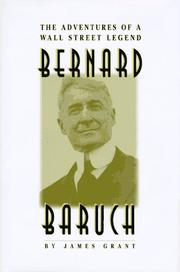
Bernard M. Baruch: The Adventures of a Wall Street Legend
Open Library unreachable during build; title listed on grantspub.com books page
Summary
Grant wrote this early biography of Bernard Baruch, the speculator who became a public figure as an adviser to presidents and as a self-appointed elder statesman.
The financial content covers Baruch's actual career, which Grant treats more sceptically than Baruch's own memoirs do. Baruch made his money as a speculator in the 1890s and 1900s, primarily through positions in mining, transport and industrial securities, often on information advantages that would not now be legal. Grant traces the specific operations, including the Amalgamated Copper campaign and the positions taken around corporate reorganisations, and shows that Baruch's method was closer to opportunistic trading on information than to the patient analysis he later described.
The public career covers the War Industries Board chairmanship during the First World War, which gave Baruch authority over industrial mobilisation and established his reputation; the interwar years as an adviser and commentator; the Baruch Plan for international control of atomic energy after 1945; and his practice of being photographed on a Central Park bench dispensing advice, which Grant treats as deliberate reputation management.
Grant's argument is that Baruch was an effective speculator who spent the second half of his life converting that into a public position, and that the wisdom he became known for was largely constructed after the fact.
The book is Grant's first and is written with the style he developed later. It is a debunking biography and readers should note that framing. Baruch's own My Own Story presents the version Grant is arguing against.
Key takeaways 7
- Baruch made his fortune as a speculator trading on information advantages rather than through the patient analysis he later described.
- His method involved positions around corporate reorganisations and campaigns in mining and industrial securities.
- The War Industries Board chairmanship converted a financial reputation into a public one that lasted forty years.
- Baruch managed his public image deliberately, including the practice of receiving visitors on a park bench.
- The investment wisdom attributed to him was largely constructed retrospectively rather than practised at the time.
- Information advantages that were routine in his period would constitute illegal insider trading today.
- A financial reputation can be converted into political influence, and the influence then reinforces the financial reputation.
Who should read it
Readers interested in early twentieth-century speculation and in how financial reputations are constructed after the fact.
About James Grant
Founder and editor, Grant's Interest Rate Observer (since 1983); financial historian and biographer
Grant's Interest Rate Observer is a primary source other investors read and quote, and Money of the Mind is a standard credit history.
Where it sits in the reference 2
Similar books 6
Chosen by shared topics, the entries that hold them, and the people who recommended both.