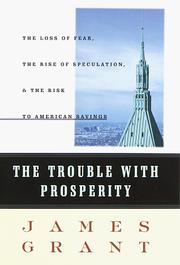
The Trouble with Prosperity: The Loss of Fear, the Rise of Speculation, and the Risk to American Savings
Open Library unreachable during build; title listed on grantspub.com books page
Summary
Grant, the founder of Grant's Interest Rate Observer, argues that prosperity produces the conditions for its own reversal. His mechanism is straightforward: sustained good times reduce the memory of loss, which reduces the risk premium investors demand, which lowers the cost of capital, which funds investment and speculation that would not survive normal conditions.
He develops the argument through financial history rather than through models. The extended cases include the American 1920s and the deflation that followed, the postwar decades, the Japanese bubble of the late 1980s and its collapse, the American real estate and savings and loan episode, and the state of markets in the mid-1990s. He pays particular attention to credit, arguing that the price of money and the willingness of lenders to lend govern asset cycles more directly than earnings do, and that the accumulation of debt during good times is what makes the reversal violent.
Grant also argues against the belief, which he saw forming in the mid-1990s, that central banks and improved policy had ended the cycle. He treats confidence in policy as itself a component of the bubble.
The forecast was early and, as a market call, wrong. Grant was bearish through a period when American equities rose substantially, and readers should treat his timing accordingly. The historical analysis has aged much better than the prediction, and the credit-cycle framework anticipates a great deal of what was written after 2008. The book is dense with financial detail and Grant's style is allusive, which makes it slower reading than its length suggests.
Key takeaways 7
- Prosperity destroys the memory of loss, and the falling risk premium that follows is what finances the next excess.
- Credit conditions drive asset cycles more directly than earnings or economic growth do.
- Debt accumulated during expansions is the mechanism that turns an ordinary downturn into a violent one.
- Confidence that policymakers have abolished the cycle is itself a reliable indicator of a late-stage cycle.
- Japan's bubble and collapse in the 1980s and 1990s followed the same credit dynamics as the American 1920s.
- Falling interest rates raise asset prices while simultaneously reducing the compensation investors receive for risk.
- Financial history is the only available laboratory for economics, because the experiments cannot be run any other way.
Who should read it
Investors who want a credit-cycle framework built from financial history, with the warning that Grant's market timing in this book was wrong for years.
About James Grant
Founder and editor, Grant's Interest Rate Observer (since 1983); financial historian and biographer
Grant's Interest Rate Observer is a primary source other investors read and quote, and Money of the Mind is a standard credit history.
Where it sits in the reference 2
Who recommended it 1 · 1 direct
Similar books 6
Chosen by shared topics, the entries that hold them, and the people who recommended both.