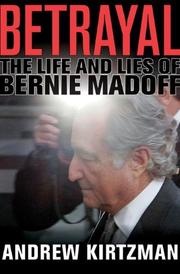
Betrayal: The Life and Lies of Bernie Madoff
Fast first draft, published months after the arrest.
Summary
Kirtzman, a New York television reporter, wrote one of the first books on Bernard Madoff after the December 2008 confession. It covers Madoff's life from Queens, the founding of his market-making firm, his role in the development of Nasdaq and electronic trading, the growth of the advisory business, and the collapse.
The substantive content concerns how the fraud was sustained. Madoff ran a legitimate and technically sophisticated market-making operation on one floor while the advisory business operated on another with a small staff and no independent administrator, custodian or auditor of any standing. Investors received paper statements showing a split-strike conversion strategy that would have required options volumes exceeding the entire market. Feeder funds, including Fairfield Greenwich and Access International, gathered money and charged fees for doing so while performing minimal diligence. Madoff cultivated exclusivity, turning investors away, which functioned as marketing. Harry Markopolos submitted detailed analyses to the Securities and Exchange Commission repeatedly over years, and the agency examined Madoff several times without discovering the fraud.
Kirtzman also covers the social world, particularly the Palm Beach and Jewish philanthropic networks through which the money was raised, and the effect on charities that lost endowments.
The book was written fast, within months of the arrest, and it shows: the reporting relies heavily on interviews with people around Madoff rather than on documents that were not yet available. Diana Henriques's The Wizard of Lies, also in this reference, is the more thorough account. Kirtzman later published a revised and expanded version. The description of the diligence failures is accurate and is the part worth reading.
Key takeaways 7
- The advisory business had no independent custodian, administrator or credible auditor, which was visible to anyone who asked.
- The stated options strategy would have required trading volumes larger than the entire relevant options market.
- Feeder funds collected fees for gathering assets while performing diligence that would not have survived scrutiny.
- Restricting access and turning investors away functioned as a marketing device rather than as a constraint.
- The Securities and Exchange Commission examined Madoff several times and failed to check whether the securities existed.
- Harry Markopolos supplied the regulator with a specific quantitative case over a period of years and was not acted on.
- Affinity networks in philanthropy and social clubs substituted for diligence among sophisticated and unsophisticated investors alike.
Who should read it
Allocators and investors who want the diligence failures catalogued, though Henriques's account is more complete.
Where it sits in the reference 3
Similar books 6
Chosen by shared topics, the entries that hold them, and the people who recommended both.


