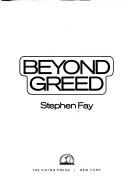
Beyond Greed
The Hunt brothers' attempt to corner silver and the 1980 collapse.
Summary
Fay, a British journalist, wrote the account of the Hunt brothers' attempt to corner the silver market, which culminated in the collapse of March 1980.
The narrative traces Nelson Bunker Hunt and William Herbert Hunt, heirs to an oil fortune, accumulating silver from the early 1970s, initially as an inflation hedge and then as a deliberate position large enough to affect the price. They took delivery of physical metal rather than rolling futures contracts, which removed supply from the market, and they partnered with Saudi investors to extend the position. Silver rose from around six dollars an ounce in early 1979 to nearly fifty in January 1980.
The collapse came from rule changes. The Commodity Exchange and the Chicago Board of Trade raised margin requirements and then imposed liquidation-only trading, meaning new long positions could not be opened. The price fell, the Hunts faced margin calls they could not meet, and on Silver Thursday in March 1980 the position was liquidated, threatening the solvency of their brokers including Bache. A bank syndicate arranged a loan to unwind the position in an orderly way, with the Federal Reserve's involvement, to prevent a broader failure.
Fay's analysis covers the role of the exchanges, whose boards included members with short positions, and the question of whether the rule changes were legitimate market management or an intervention against the Hunts specifically.
The book was published in 1982, before the civil litigation concluded and before the Hunts' 1988 bankruptcy. It is journalism rather than commodity market analysis. The general lesson, that a corner requires holding a position larger than one's ability to finance it and that the rules can be changed by parties on the other side, is the durable content.
Key takeaways 7
- The Hunts took physical delivery rather than rolling futures, which removed metal from the deliverable supply and drove the price.
- Silver rose roughly eightfold in a year on a position built deliberately to affect the price.
- Exchange rule changes raising margins and restricting new long positions ended the corner rather than any change in fundamentals.
- Exchange boards included members holding short positions, which raises the question of whose interest the rule changes served.
- A cornered position is only sustainable while the holder can finance the margin, and margin requirements can be raised against them.
- The unwinding required a bank syndicate loan arranged with Federal Reserve involvement to prevent broker failures.
- A position large enough to move a market is also large enough that it cannot be exited without moving the market against the holder.
Who should read it
Traders and risk managers who want the definitive case study of a market corner and of how rule changes can be used against a concentrated position.
Where it sits in the reference 2
Similar books 6
Chosen by shared topics, the entries that hold them, and the people who recommended both.