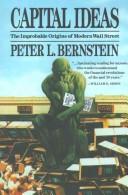
Capital Ideas: The Improbable Origins of Modern Wall Street
Open Library unreachable during build; every openlibrary.org query failed with connection errors
Summary
Bernstein tells the intellectual history of modern finance through the people who built it: Bachelier on random walks in 1900, Markowitz on portfolio selection, Modigliani and Miller on capital structure, Tobin on separation, Sharpe on the capital asset pricing model, Samuelson and Fama on efficient markets, Black, Scholes and Merton on option pricing, and Wells Fargo's practitioners who turned the theory into products.
His argument is that ideas developed in university economics departments, initially with no practical intent and often with contempt from practitioners, produced almost every technique Wall Street now uses. He shows the sequence: Markowitz made risk quantifiable as variance and made diversification a computation rather than a maxim; Sharpe reduced portfolio risk to a single factor and made beta measurable; efficient markets research showed managers were not beating the index; and Black-Scholes made options tradeable by making them priceable. He then shows each idea's conversion into a product, including index funds, portfolio insurance and derivatives desks.
Bernstein interviewed almost all the surviving principals and the book is the standard account. Its weakness is timing and sympathy. Written in 1992, it treats the theoretical apparatus as largely settled, and the events that followed, including 1987, Long-Term Capital Management and 2008, tested the assumptions harder than the book anticipates. Bernstein addressed this in Capital Ideas Evolving. The behavioural challenge to efficient markets is present but treated as a minor qualification rather than as the serious research programme it became.
Key takeaways 7
- Almost every technique used in modern portfolio management originated in academic work done without practical intent and initially rejected by practitioners.
- Markowitz made diversification a computation by defining risk as variance and showing that the correlation between holdings, not their individual risk, determines portfolio risk.
- The capital asset pricing model made risk measurable as a single number and thereby made performance measurement against a benchmark possible.
- Modigliani and Miller showed that capital structure does not change firm value under stated conditions, which reframed every subsequent argument about debt as an argument about which condition fails.
- Efficient market research established that professional managers as a group do not beat the index, which produced index funds as a direct consequence.
- The Black-Scholes formula made options priceable and therefore tradeable, and the market for them appeared almost immediately after the formula did.
- Financial theory and financial practice converged because the theory made new products possible, not because practitioners were persuaded by the arguments.
Who should read it
Investors who want the intellectual history of the tools they use and an understanding of what each one assumes.
About Peter L. Bernstein
Founder, Peter L. Bernstein Inc.; founding editor of The Journal of Portfolio Management; economist and financial historian (1919-2009)
Against the Gods and Capital Ideas are the standard accounts of risk and of modern finance theory, read across the whole field.
Where it sits in the reference 5
Similar books 6
Chosen by shared topics, the entries that hold them, and the people who recommended both.