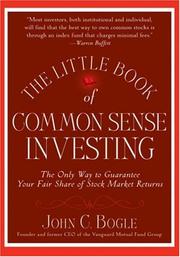
The Little Book of Common Sense Investing
Own the whole market at low cost; the index case in its shortest form.
Summary
Bogle founded Vanguard and created the first retail index fund in 1976, and this book states his case in short chapters. The argument is arithmetic rather than empirical. All investors collectively hold the market, so before costs their aggregate return equals the market return. After costs, their aggregate return must be less than the market return by exactly the amount of the costs. Therefore the average actively managed dollar must underperform the market by the amount of its expenses, and this holds regardless of manager skill.
Bogle then documents the size of those costs, which include expense ratios, trading commissions, bid-ask spreads, cash drag and taxes generated by turnover. He argues that the total is far above the headline expense ratio, and that compounded over decades it consumes a very large share of the return an investor would otherwise receive. His arithmetic on a fifty-year horizon shows costs taking most of the cumulative gain.
He adds evidence on the persistence of fund performance, showing that past outperformance does not predict future outperformance, that survivorship bias inflates reported industry returns because failed funds disappear from the record, and that investor returns fall below fund returns because money arrives after good performance and leaves after bad.
His prescription is a low-cost broad market index fund held indefinitely, with no market timing and minimal trading. The book repeats itself and Bogle's tone is moralising. He is hostile to exchange-traded funds mainly because they facilitate trading. Critics raise the growth of index ownership and its effect on corporate governance and price discovery, questions the book does not address. The core arithmetic is not disputable.
Key takeaways 8
- All investors collectively own the market, so their aggregate return before costs equals the market return and their aggregate return after costs must be lower by exactly the costs.
- The total cost of active management substantially exceeds the stated expense ratio once trading costs, cash holdings and tax consequences are included.
- Costs compound against the investor over decades and consume a large share of the cumulative return that would otherwise accrue.
- Past fund performance does not predict future performance, and funds that outperform in one period do not do so reliably in the next.
- Reported industry performance is inflated by survivorship bias because failed funds are removed from the record.
- Investors earn less than the funds they hold, because money enters after strong performance and exits after weak performance.
- Reversion to the mean applies to fund performance and to market sectors, so extrapolating recent returns produces systematic errors.
- Owning the entire market at minimum cost and holding indefinitely captures the return that the average investor gives away in fees and trading.
Who should read it
Any investor deciding between active and passive management who wants the arithmetic case stated in its simplest and most direct form.
About John C. Bogle
Founder and CEO, The Vanguard Group 1974-1996; creator of the first retail index mutual fund
He built the institution and wrote the primary-source case for low-cost indexing that every later index advocate builds on.
Where it sits in the reference 7
Who recommended it 6 · 3 direct
Similar books 6
Chosen by shared topics, the entries that hold them, and the people who recommended both.