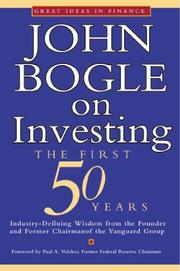
John Bogle on Investing: The First 50 Years
Collected Bogle essays on costs, fiduciary duty and indexing.
Summary
This collects Bogle's speeches, articles and testimony across his career, from his 1951 Princeton thesis on the mutual fund industry through his years running Vanguard and afterwards. It is organised thematically rather than chronologically.
The collection's advantage is that it shows the consistency of the argument across five decades and shows what he said before outcomes were known. The Princeton thesis argued that funds should operate in the most efficient, honest and economical way possible and should not claim superiority over market averages, which is the position he acted on twenty-four years later in creating the index fund.
The substantive material covers the arithmetic of costs, the failure of past performance to predict future performance, reversion to the mean across managers and styles, the structural conflict between fund management company profitability and fund shareholder returns, the mutual ownership structure Vanguard uses and why no competitor adopted it, the effect of taxes and turnover, and the corporate governance failures of institutional owners.
Several pieces are testimony to Congress and to the Securities and Exchange Commission, which state the industry criticism in a more direct register than his books. The collection overlaps substantially with his other books, since he made the same arguments repeatedly and by design. Readers who have read Common Sense on Mutual Funds will find the analysis familiar. The value here is the chronological evidence of a position stated early and held, which is a form of evidence that most investment writing cannot offer.
Key takeaways 8
- Bogle's 1951 thesis argued that funds should not claim superiority over market averages, which is the position he acted on in creating the index fund in 1975.
- The aggregate return to investors equals the market return minus costs, which holds regardless of any manager's skill.
- Past fund performance does not predict future performance, and reversion to the mean applies across managers, styles and asset classes.
- Fund management companies face a permanent structural conflict between their own profitability and the returns of fund shareholders.
- The mutual ownership structure Vanguard uses resolves that conflict, and no competitor adopted it because it removes the profit.
- Taxes and turnover are among the largest costs to taxable investors and are almost entirely absent from how funds are marketed.
- Institutional owners hold most corporate equity and do not act as owners, which leaves companies effectively unsupervised.
- The collection shows a position stated in 1951 and held for five decades, which is a form of evidence most investment writing cannot offer.
Who should read it
Investors who want Bogle's arguments in their original form across fifty years, including the testimony that states the industry criticism most directly.
About John C. Bogle
Founder and CEO, The Vanguard Group 1974-1996; creator of the first retail index mutual fund
He built the institution and wrote the primary-source case for low-cost indexing that every later index advocate builds on.
Where it sits in the reference 3
Who recommended it 2 · 1 direct
Similar books 6
Chosen by shared topics, the entries that hold them, and the people who recommended both.