Common Sense on Mutual Funds
Vanguard's founder on costs, turnover and fund structure.
Summary
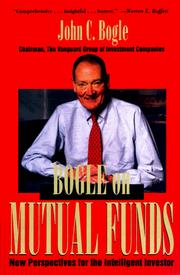
Bogle's longest and most detailed book covers investment strategy, fund choice, fund performance and the structure of the fund industry. It is more technical than his shorter works and contains substantial data on returns, costs and the persistence of performance. The strategy section covers long-term returns decomposed into dividend yield, earnings growth and change in valuation, which Bogle uses to build forward return estimates rather than extrapolate past results. He covers asset allocation, arguing that the stock and bond split is the dominant determinant of portfolio outcomes, and treats time horizon, taxes and reversion to the mean throughout.
The fund choice section documents the arithmetic of costs in detail, showing how expense ratios, turnover costs and tax inefficiency compound over decades. He presents data on the survivorship of funds, on the failure of past performance to predict future performance, and on the tendency of large successful funds to close to new money too late.
The industry section is the most pointed. Bogle argues that mutual fund management companies have a fiduciary duty to shareholders that conflicts directly with their own profitability as businesses, that the industry shifted from a profession to a marketing business, and that fund directors do not act as independent agents. He argues for the mutual ownership structure Vanguard uses as the resolution.
The book was published in 1999 with a tenth anniversary edition in 2009, and the data is dated. It is long and repeats arguments Bogle made elsewhere. The forward return methodology and the detailed cost arithmetic are the parts that justify the length over his shorter books.
Key takeaways 8
- Long-run equity returns decompose into dividend yield, earnings growth and change in valuation, which allows a forward estimate rather than an extrapolation of past returns.
- The allocation between stocks and bonds determines portfolio outcomes more than security selection or timing.
- Total costs of fund ownership substantially exceed the stated expense ratio once turnover and tax consequences are included.
- Past fund performance does not predict future performance, and the funds that outperform in one decade are not the ones that outperform in the next.
- Reversion to the mean applies across managers, styles and asset classes, so recent outperformance is evidence of a future shortfall rather than of skill.
- Fund management companies face a permanent conflict between their fiduciary duty to fund shareholders and their own profitability.
- Fund directors do not function as independent agents of shareholders, which removes the governance check the structure assumes.
- Taxes are the largest cost for many taxable investors and are almost entirely ignored in how funds are marketed and evaluated.
Who should read it
Investors who want the detailed data and forward return methodology behind Bogle's arguments rather than the compressed version in his shorter books.
About John C. Bogle
Founder and CEO, The Vanguard Group 1974-1996; creator of the first retail index mutual fund
He built the institution and wrote the primary-source case for low-cost indexing that every later index advocate builds on.
Where it sits in the reference 6
Who recommended it 5 · 1 direct
Similar books 6
Chosen by shared topics, the entries that hold them, and the people who recommended both.