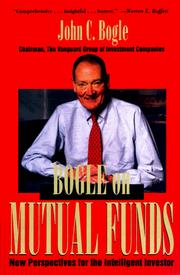
Bogle on Mutual Funds
The earlier, more instructional Bogle book on fund selection.
Summary
Bogle's first book is a practical manual for choosing and holding mutual funds, written before indexing had won the argument. It explains what mutual funds are, how their costs work, how to read a prospectus, and how to build a portfolio across equity, bond and money market funds according to time horizon and risk tolerance.
The analytical core is Bogle's cost-matters argument, developed here more carefully than in his later, shorter books. He decomposes fund returns into market return minus expense ratio, transaction costs, sales loads and taxes, and shows with fund-industry data that the resulting drag explains most of the gap between what funds earn and what the market earns. He introduces the four dimensions on which he says investors should judge a fund: return, risk, cost and time. He also argues that past performance carries almost no information about future performance except in the case of costs, which persist.
The book is dated in its particulars. Fund industry structures, expense levels, tax rules and the available product set have all changed substantially since 1993, and the specific fund recommendations are of historical interest only. What survives is the framework for evaluating any managed product, the reversion-to-the-mean evidence, and the argument that asset allocation should be set by the investor's time horizon rather than by market forecasts. Bogle also states his objection to what he later called the index fund's misuse, and readers should note that his later works cover the same ground more concisely.
Key takeaways 7
- Fund costs are the only reliable predictor of relative fund performance, because they persist while returns do not.
- Investors should evaluate a fund on four dimensions together, being return, risk, cost and holding period, rather than on return alone.
- Past performance rankings reverse over time as returns revert to the mean of the fund's asset class.
- The dominant determinant of a portfolio's outcome is the split between stocks and bonds, which should be set by the investor's time horizon.
- Sales loads, 12b-1 fees and portfolio turnover costs are additive drags that compound against the investor over decades.
- Funds that concentrate in a narrow sector or style expose the investor to risk that is not compensated by higher expected return.
- Simplicity in a portfolio is a decision advantage rather than a compromise, since complexity increases both cost and the chance of behavioural error.
Who should read it
Individual investors who want Bogle's cost argument in its fullest form, though most readers will get the same conclusions faster from his later books.
About John C. Bogle
Founder and CEO, The Vanguard Group 1974-1996; creator of the first retail index mutual fund
He built the institution and wrote the primary-source case for low-cost indexing that every later index advocate builds on.
Where it sits in the reference 4
Who recommended it 1
Similar books 6
Chosen by shared topics, the entries that hold them, and the people who recommended both.