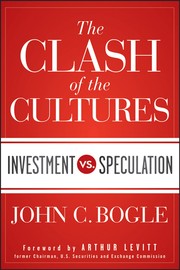
The Clash of the Cultures: Investment vs. Speculation
Summary
Bogle argues that speculation has displaced investment as the dominant activity in financial markets, and documents the shift with turnover data, holding period data and fund industry statistics. His central evidence is the change in equity turnover. He shows that annual turnover rose from around twenty-five percent in the mid-twentieth century to multiples of the total market value, and that average mutual fund holding periods fell from years to months. He argues that this activity transfers wealth from investors to intermediaries without creating anything, since the aggregate return to investors is the market return minus costs regardless of how much trading occurs.
He extends the argument to the fund industry's transformation from management companies owned by their partners into subsidiaries of financial conglomerates, which he argues changed the objective from serving fund shareholders to gathering assets. He documents the proliferation of funds launched to capture whatever is currently performing well, and the record of those funds afterwards.
His chapters on exchange traded funds are the most contested. Bogle accepted index funds and objected to instruments that facilitate intraday trading, arguing that they convert a long-term instrument into a speculative one, and he presents data on the returns investors actually received in traded index products versus the products' own returns.
He also covers pension and retirement system failures, corporate governance and the failure of institutional owners to act as owners. The book repeats arguments Bogle made across his other books and the moralising tone is heavy. The turnover data and the investor return versus fund return gap are the substantive contributions.
Key takeaways 8
- Equity turnover rose from around a quarter of market value annually to multiples of it, which is the measurable shift from investment to speculation.
- Trading activity transfers wealth from investors to intermediaries without creating anything, since aggregate investor return equals market return minus costs.
- Fund holding periods fell from years to months, which means funds themselves became speculative instruments rather than investment vehicles.
- Fund management companies owned by financial conglomerates optimise for asset gathering rather than for the returns of fund shareholders.
- Funds are launched to capture whatever is currently performing well, and their subsequent returns are systematically poor.
- Investors in traded index products earned less than the products themselves returned, because the trading capability was used.
- Institutional owners hold the majority of corporate equity and do not act as owners, which leaves companies effectively unsupervised.
- The retirement system transferred investment risk to individuals without giving them the tools or the costs structure to bear it.
Who should read it
Investors and trustees who want the data behind the argument that market activity has become extractive rather than allocative.
About John C. Bogle
Founder and CEO, The Vanguard Group 1974-1996; creator of the first retail index mutual fund
He built the institution and wrote the primary-source case for low-cost indexing that every later index advocate builds on.
Where it sits in the reference 3
Who recommended it 3 · 2 direct
Similar books 6
Chosen by shared topics, the entries that hold them, and the people who recommended both.