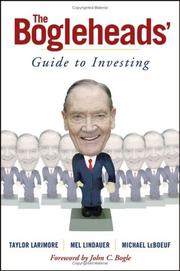
The Bogleheads' Guide to Investing
The practical application of Bogle's rules to a household portfolio.
Summary
Taylor Larimore, Mel Lindauer and Michael LeBoeuf wrote this from the community that formed around John Bogle's investment principles, and it functions as a complete personal finance manual organised around low-cost index investing.
The investment content is simple and consistently applied: hold a diversified portfolio of low-cost index funds across domestic equities, international equities and bonds; set an asset allocation appropriate to age and risk tolerance and rebalance to it; do not attempt to time markets or select managers; minimise costs and taxes; and stay the course during declines. The authors present the evidence on active manager underperformance and on the cost drag as the justification.
The book also covers the surrounding personal finance questions that determine outcomes more than portfolio choice does: living below one's means, paying off high-interest debt first, using tax-advantaged accounts in the correct order, choosing between traditional and Roth treatment, insurance decisions, estate planning basics and the treatment of a house. It covers the behavioural traps and how to avoid them. The material is specific to American tax and account structures, which limits it elsewhere, and the specific fund recommendations date. The framework is the mainstream consensus of financial economics applied to a household, and it is presented without anything to sell.
Key takeaways 7
- Costs are the most reliable predictor of fund performance, and minimising them is the only edge available to almost every investor.
- An investor should choose an asset allocation, hold it through declines, and rebalance mechanically rather than by judgement.
- Active manager selection fails because the small number who outperform cannot be identified in advance from past performance.
- Tax-advantaged account order and asset location between account types affect returns more than security selection does.
- Personal savings rate determines retirement outcomes more than investment returns do for most people.
- Complexity in a portfolio adds cost and behavioural risk without adding expected return.
- The authors argue that the hardest part of the strategy is doing nothing during market declines, which is where most investors fail.
Who should read it
Individual investors who want a complete, unconflicted personal finance and portfolio manual built on the index fund consensus.
Where it sits in the reference 2
Similar books 6
Chosen by shared topics, the entries that hold them, and the people who recommended both.