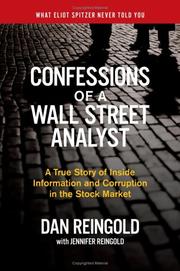
Confessions of a Wall Street Analyst
Insider account of the analyst-banking nexus that financed Ebbers's roll-up.
Summary
Reingold covered telecommunications as a sell-side analyst at Morgan Stanley, Merrill Lynch and Credit Suisse First Boston through the 1990s and the bubble, and wrote this account of the conflicts he worked under.
The structural material is the substance. Reingold explains how analyst compensation actually worked: analysts were paid substantially from investment banking revenue attributed to their sector, so an analyst whose ratings prevented the firm from winning underwriting mandates earned less. He describes being present at pitches for banking business, being asked about his rating by bankers and by issuers, and the understanding that a negative rating on a potential client had consequences.
He also documents selective disclosure. Before Regulation Fair Disclosure took effect in 2000, companies routinely gave analysts material information privately, and Reingold describes receiving guidance on results before publication and passing it to favoured institutional clients, which was standard practice rather than misconduct at the time.
His running comparison is with Jack Grubman at Salomon Smith Barney, the period's most prominent telecommunications analyst, who was openly involved in banking transactions for the companies he covered and who was later barred from the industry. Reingold argues that Grubman's approach was rewarded by the market while more conservative analysis was punished, and he documents the effect on his own standing and compensation.
The book is a participant's account and presents the author as having behaved better than his peers, which readers should discount. Its value is the description of how the compensation and information structures actually operated, which the regulatory settlements addressed but which the settlements themselves do not explain.
Key takeaways 7
- Analyst compensation was drawn substantially from investment banking revenue attributed to the analyst's sector.
- An analyst whose ratings cost the firm underwriting mandates earned less, which made negative ratings personally expensive.
- Analysts attended pitches for banking business and were asked about their ratings by bankers and by issuers.
- Companies gave analysts material information privately before Regulation Fair Disclosure, and analysts passed it to favoured clients.
- The market rewarded analysts who were most closely involved with banking and punished those who were more conservative.
- Selective disclosure meant institutional clients received information days before it reached the public.
- The compensation structure produced the conflicted research without requiring any individual to act dishonestly.
Who should read it
Investors who want a participant's account of how sell-side research incentives operated before and during the regulatory reforms.
Where it sits in the reference 2
Similar books 6
Chosen by shared topics, the entries that hold them, and the people who recommended both.