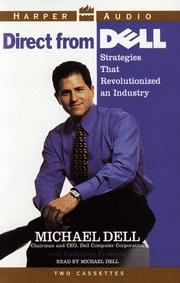
Direct from Dell
Insider account of build-to-order, negative working capital and cutting the channel.
Summary
Dell wrote this in 1999 with Catherine Fredman, covering the company from the University of Texas dormitory through its position as one of the largest computer manufacturers in the world.
The business model is the substance. Selling directly to customers rather than through retailers removed the channel margin, removed the inventory sitting in the channel, and gave Dell direct information about what customers actually wanted rather than what retailers reported. Build to order meant components were purchased after the order was placed, which in an industry where component costs fell continuously meant Dell's inventory was worth more than competitors' at every point in the cycle.
The financial consequence is the most instructive part. Negative working capital, meaning customers paid before suppliers were due, financed growth without external capital. Dell explains the cash conversion cycle explicitly and treats inventory turns as the governing operational metric. He also covers the early crises including a period of growth outrunning the company's systems, the failed retail experiment which he abandoned, and the entry into servers. The management material covers segmentation of the business as it grew, the practice of splitting business units when they reached a size at which the manager could no longer know the operations, and the metrics used.
The book was written at the peak of the model's advantage and reads as such. The direct model's advantage disappeared as component prices stabilised, as competitors improved their supply chains and as retail changed. Dell's later books cover the subsequent period. The cash conversion and inventory turn material transfers to any physical goods business.
Key takeaways 8
- Selling directly removed the channel margin, removed channel inventory and gave the company direct information about customer demand.
- Build to order meant components were purchased after the order, which in an industry with falling component costs made inventory worth more than competitors'.
- Negative working capital, with customers paying before suppliers were due, financed growth without external capital.
- Inventory turns rather than gross margin was the governing operational metric, since speed determined the cost advantage.
- Direct customer relationships produced information about demand that competitors received filtered through retailers and weeks later.
- Business units were split when they grew beyond the size at which a manager could know the operations directly.
- The retail experiment failed and was abandoned quickly, which Dell treats as a straightforward correction rather than concealing.
- The direct model's advantage depended on falling component costs and on competitors having worse supply chains, and both conditions ended.
Who should read it
Operators in physical goods businesses who want the cash conversion cycle and inventory economics explained by someone who built a business on them.
About Michael Dell
Founder, chairman and chief executive of Dell Technologies, which he started in a University of Texas dorm room in 1984.
Direct from Dell explains the direct-sales and build-to-order model that let the company run on negative working capital and undercut reseller-based competitors on price - one of the clearest worked examples of a cash conversion cycle as a competitive weapon. Play Nice But Win covers the 2013 leveraged buyout that took Dell private, the proxy fight with Carl Icahn, and the EMC purchase and VMware tracking stock that followed.
Where it sits in the reference 4
Who recommended it 2 · 1 direct
Similar books 6
Chosen by shared topics, the entries that hold them, and the people who recommended both.