Play Nice But Win
Dell's founder on the buyout, the Icahn fight and VMware
Summary
Dell structures the book around three fights: the founding and early growth of Dell from a University of Texas dormitory, the 2013 leveraged buyout that took the company private against Carl Icahn's opposition, and the 2016 acquisition of EMC, the largest technology deal ever completed at that point, followed by the return to public markets through the VMware tracking stock.
The buyout chapters are the substance. Dell describes concluding that the transformation from a personal computer maker to an enterprise solutions company could not be executed under quarterly reporting, the process of assembling financing with Silver Lake and a loan from Microsoft, the special committee process, the go-shop period, Icahn's campaign and the proxy fight, and the eventual price increase and vote structure change that got the deal done. The account of dealing with an activist investor in public is unusually detailed from the target's side.
The EMC chapter covers the negotiation with Joe Tucci, the sixty-seven billion dollar structure, the tracking stock mechanism for VMware, and the debt load taken on to complete it. The early Dell history is told more briefly here than in Direct from Dell, and covers the direct sales model, build to order, negative working capital and the inventory advantage over the indirect channel.
The book is a chief executive's account of his own decisions and reads as vindication throughout, since the deals worked. The failures, including the 2000s decline in Dell's competitive position, the accounting issues of that period and the challenges of the services acquisitions, receive little attention. The financing mechanics and the activist defence are the transferable parts.
Key takeaways 8
- Dell took the company private because a multi-year transformation could not be executed while reporting quarterly to public shareholders.
- The direct model produced negative working capital, meaning customers paid before suppliers were due, which financed growth without external capital.
- An activist campaign against a founder-led buyout is fought over the fairness process and the shareholder vote mechanics rather than over the business case.
- A special committee process transfers control of the sale to independent directors, which constrains a founder buyer more than outside observers assume.
- The EMC acquisition was financed with debt on a scale that required specific asset sales and a tracking stock structure to be feasible.
- Combining hardware, storage, virtualisation and services was Dell's bet that enterprise customers would buy an integrated stack rather than assemble one.
- A founder returning to control requires aligning incentives with a private equity partner whose exit horizon differs from the founder's.
- Dell argues that the private period allowed investment decisions with payback horizons that public markets would have punished.
Who should read it
Founders and executives considering going private, facing activist investors, or financing a large transformative acquisition.
About Michael Dell
Founder, chairman and chief executive of Dell Technologies, which he started in a University of Texas dorm room in 1984.
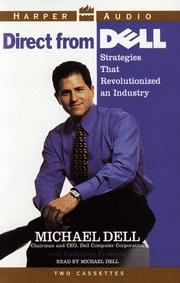
Direct from Dell explains the direct-sales and build-to-order model that let the company run on negative working capital and undercut reseller-based competitors on price - one of the clearest worked examples of a cash conversion cycle as a competitive weapon. Play Nice But Win covers the 2013 leveraged buyout that took Dell private, the proxy fight with Carl Icahn, and the EMC purchase and VMware tracking stock that followed.
Where it sits in the reference 3
Who recommended it 9
Similar books 6
Chosen by shared topics, the entries that hold them, and the people who recommended both.