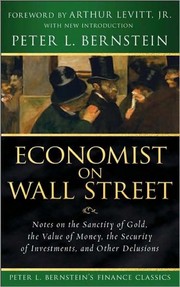
Economist on Wall Street
Open Library unreachable during build; every openlibrary.org query failed with connection errors
Summary
The reference has not verified this book in detail; the summary states only what the title, author and subject establish.
Bernstein published this in 1970, drawing on his experience running an investment counselling firm and writing about markets from an economist's perspective. It was reissued in 2008 with commentary by Peter Bernstein written shortly before his death.
The reference has not verified the book's detailed contents. What the period and the author establish is the context: Bernstein was writing at the end of the 1960s bull market, before the 1973 and 1974 collapse, before the inflation of that decade, before modern portfolio theory had been adopted in practice, and before index funds existed.
Bernstein's recurring positions across his career, which are visible in his later and better known books including Against the Gods and Capital Ideas, include the primacy of risk over return in investment thinking, scepticism about forecasting, attention to the relationship between economic conditions and asset prices, and an insistence that investors understand the assumptions embedded in whatever they hold.
A 1970 book on investing and economics is now a period document. The institutional environment, the tax treatment, the instruments available and the professional practice have all changed completely. The 2008 reissue was published because the questions Bernstein was raising about inflation, about the relationship between economic growth and equity returns, and about the limits of forecasting had become relevant again.
Readers wanting Bernstein's substantive contributions should read Against the Gods for the history of risk and Capital Ideas for the development of financial theory. This volume is of historical interest.
Key takeaways 6
- Bernstein wrote as an economist managing money, which was an unusual combination when investment practice and academic economics had little contact.
- The book was published at the end of the 1960s bull market, before the collapse and the inflation that followed.
- Its institutional context, including tax treatment, available instruments and professional practice, has changed completely.
- Bernstein's recurring position across his career was that risk rather than return should organise investment thinking.
- He was consistently sceptical of forecasting including by economists, which was his own profession.
- The 2008 reissue was prompted by the return of questions about inflation and about growth and equity returns.
Who should read it
Readers interested in Bernstein's early work as a period document, who should read Against the Gods and Capital Ideas for his substantive contributions.
About Peter L. Bernstein
Founder, Peter L. Bernstein Inc.; founding editor of The Journal of Portfolio Management; economist and financial historian (1919-2009)
Against the Gods and Capital Ideas are the standard accounts of risk and of modern finance theory, read across the whole field.
Where it sits in the reference 2
Similar books 6
Chosen by shared topics, the entries that hold them, and the people who recommended both.