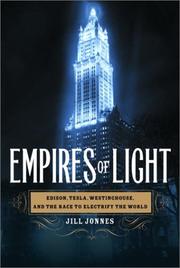
Empires of Light
The current war: Edison against Westinghouse and Tesla.
Summary
Jonnes tells the history of electrification in the United States through three figures: Thomas Edison, who built the first commercial direct current system in lower Manhattan; George Westinghouse, who backed alternating current and had the industrial capacity to deploy it; and Nikola Tesla, whose polyphase alternating current motor made the system practical. The narrative runs from the 1870s through the Niagara Falls power project of the mid-1890s.
The substance is the current war. Edison's direct current worked only over short distances and required generating stations every mile, which made it viable in dense city centres and nowhere else. Alternating current could be transformed to high voltage for transmission and back down for use, which meant one large plant could serve a region. Edison's response was a public campaign about the dangers of high voltage, including his involvement in the use of alternating current for the first electric chair execution. He lost the technical argument, and lost control of his own company when it was merged into General Electric by financiers who wanted the alternating current patents.
Jonnes works from company records, patent litigation and contemporary press. For investors the case is about standards competition: the winning technology was chosen by the physics of transmission economics, not by the strength of the incumbent or the quality of its marketing, and the incumbent's founder was removed by his own financial backers when he refused to switch. The book is popular history and its treatment of Tesla is more sympathetic than more recent scholarship supports, particularly on the later years and the Wardenclyffe project.
Key takeaways 7
- Alternating current won because transformers allowed long-distance transmission at high voltage, which changed the economics of generation scale.
- Edison lost control of his company because his financial backers valued the alternating current patents more than his commitment to direct current.
- Tesla's polyphase induction motor supplied the missing component that made alternating current usable for industrial power rather than only lighting.
- Edison ran a deliberate safety campaign against alternating current, including promoting its use in executions, after he had already lost the technical case.
- Westinghouse's manufacturing capacity and willingness to underbid at Niagara mattered as much as the technology in deciding the standard.
- Patent litigation, not product competition, consumed the majority of both companies' resources during the standards fight.
- The Niagara Falls installation settled the question publicly, and the standard then locked in for more than a century.
Who should read it
Investors and founders in infrastructure or standards-driven markets who want a documented case of how transmission economics, not incumbency, decided a technology contest.
Where it sits in the reference 4
Who recommended it 1
Similar books 6
Chosen by shared topics, the entries that hold them, and the people who recommended both.