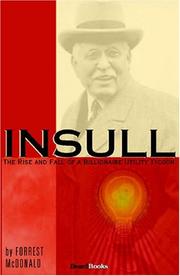
Insull
The man who invented the regulated-return utility bargain, and the holding company that killed him.
Summary
Forrest McDonald wrote the standard biography of Samuel Insull, the English-born secretary to Thomas Edison who built the Chicago electric utility system and then a holding-company empire that collapsed in 1932. McDonald had access to Insull's papers and to Commonwealth Edison's records, and the book is both a business history of the electric utility industry and a revisionist defence of its subject.
The operating history is the strongest part. McDonald explains how Insull worked out the economics of central station generation: that the fixed costs of a generating plant are recovered only through high load factors, that diversity of demand across customer types raises the load factor, and that the way to build the business is therefore to seek every class of customer, including cheap off-peak industrial load, rather than to price for maximum margin. He describes Insull's adoption of demand-based rate structures, developed from Arthur Wright's work in Brighton, his promotion of state regulation as preferable to municipal ownership, and his consolidation of rural and small-town utilities into interconnected systems.
McDonald then argues that the 1932 collapse resulted from a run on the holding company's securities orchestrated by New York bankers, not from fraud or from unsound operations, and that Insull's acquittal on all criminal charges vindicated him. This is the contested part. Later historians accept much of McDonald's operating account while treating his defence of the pyramided holding company structure as too generous, since the leverage and intercompany transactions were genuinely opaque. The book remains the essential source on how the American electric utility industry was built.
Key takeaways 7
- Central station generation is a fixed-cost business, so its economics depend on load factor rather than on price per unit sold.
- Insull deliberately sought diverse customer classes because their differing demand patterns raised utilisation of the same plant.
- Two-part tariffs, charging separately for capacity and for consumption, align utility pricing with the underlying cost structure.
- Insull promoted state regulation of utilities because a legal monopoly with regulated returns was more valuable than unregulated competition.
- Interconnecting separate systems raised reliability and load factor simultaneously, which made consolidation profitable rather than merely defensive.
- McDonald argues that Insull's empire was operationally sound and failed because of a securities run at the holding company level.
- The holding company structure that funded the expansion left the operating utilities exposed to financial pressures unrelated to their own performance.
Who should read it
Investors and operators in capital-intensive utility and infrastructure businesses who want the origin of load-factor economics and of regulated-monopoly bargains.
Where it sits in the reference 2
Similar books 6
Chosen by shared topics, the entries that hold them, and the people who recommended both.