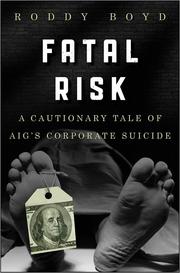
Fatal Risk: A Cautionary Tale of AIG's Corporate Suicide
The fullest dedicated account of AIG Financial Products.
Summary
Boyd, a financial journalist, reconstructed how American International Group, the largest insurer in the world, required a rescue that reached roughly one hundred and eighty billion dollars.
The explanation centres on AIG Financial Products, a unit operating from London and Connecticut that wrote credit default swaps on the senior tranches of collateralised debt obligations backed by mortgages. The unit's leadership, Joseph Cassano and before him Tom Savage, treated these as insurance on securities that would never default, because the tranches sat above enough subordination to survive any historical loss experience. Boyd shows that the models used to reach that conclusion assumed regional rather than national house price declines, and that the unit stopped writing new business in 2005 when its own analysis raised doubts, by which point the exposure was already in place.
The mechanism of failure was not default but collateral. The contracts required AIG to post collateral if the reference securities declined in value or if AIG's own credit rating fell, regardless of whether any underlying loss occurred. When mortgage security prices fell and the ratings agencies downgraded AIG, both triggers fired simultaneously and the collateral demands exceeded the group's liquidity. Boyd also covers the securities lending programme, which had invested cash collateral from lent securities into mortgage assets, producing a second and largely separate liquidity failure.
The institutional argument is that Maurice Greenberg's departure in 2005, forced by Eliot Spitzer's investigation, removed the only person who understood and constrained Financial Products, and that his successors did not.
Boyd is sympathetic to Greenberg, which readers should weigh, and the counterfactual that Greenberg would have prevented the outcome is asserted rather than demonstrated. The book is detailed on the mechanics and is the best account of the collateral trigger structure specifically.
Key takeaways 7
- AIG failed on collateral calls rather than on realised credit losses, and no underlying default was required to destroy it.
- Credit default swap contracts required collateral posting when reference prices fell and when AIG's own rating fell, so both triggers fired together.
- The models supporting the exposure assumed regional rather than nationwide house price declines, which was the load-bearing assumption.
- Financial Products stopped writing new business in 2005, which shows the unit identified the risk before the market did and could not exit what it held.
- A securities lending programme investing cash collateral in mortgage assets created a second liquidity failure independent of the derivatives book.
- An insurance company's triple-A rating was the asset that made the business possible, and it was pledged in the contracts that destroyed it.
- A small unit operating outside the group's risk framework can generate exposure that exceeds the entire firm's capital.
Who should read it
Risk managers and investors in financial institutions who need to see how contractual collateral triggers rather than credit losses can destroy a solvent company.
Where it sits in the reference 3
Similar books 6
Chosen by shared topics, the entries that hold them, and the people who recommended both.