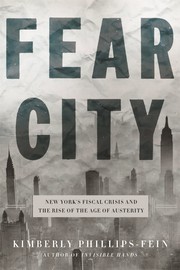
Fear City
New York's 1975 near-default and who bondholders can actually discipline.
Summary
Phillips-Fein, a historian, wrote about New York City's 1975 fiscal crisis and argued that it established a political template that spread far beyond the city.
The narrative covers how the crisis arrived. New York had built an unusually extensive set of public institutions: free tuition at the city university, a public hospital system, subsidised transport, generous welfare provision and a large unionised workforce. These were funded increasingly by short-term borrowing as the tax base eroded through manufacturing decline and middle-class departure. In 1975 the banks that had underwritten and held the city's debt refused to continue, the market closed, and the city faced default.
The resolution is the book's subject. Control over the city's finances passed to the Municipal Assistance Corporation and then the Emergency Financial Control Board, bodies dominated by bankers and state appointees rather than by elected city officials. The conditions imposed included tens of thousands of layoffs, wage freezes, service reductions, the introduction of tuition at the city university for the first time, subway fare increases, and the requirement that union pension funds purchase city bonds. The federal government initially refused assistance.
Her argument is that this was the first large-scale demonstration that a democratically elected government could be compelled by creditors to abandon its commitments, that the mechanism was the credit market rather than an election, and that the template of fiscal crisis producing externally imposed austerity was applied repeatedly afterward in other cities and later in other countries.
The book is well documented and argues a clear position. Readers who consider the fiscal position genuinely unsustainable will find her treatment of the alternatives thin. The description of the mechanism, in which credit market access substitutes for electoral accountability, is the analytically important part.
Key takeaways 7
- New York funded an expanding set of public commitments through short-term borrowing while its tax base eroded.
- When banks refused to continue underwriting the debt, the market closed and the city faced default within days.
- Financial control passed to boards dominated by bankers and state appointees rather than by elected city officials.
- Conditions imposed included mass layoffs, wage freezes, university tuition and fare increases decided outside the electoral process.
- Union pension funds were required to purchase city bonds, which placed workers' retirement savings behind the city's solvency.
- A democratically elected government was compelled by creditors to abandon commitments without any election deciding it.
- The template of fiscal crisis producing externally imposed austerity was applied repeatedly afterward in other cities and countries.
Who should read it
Readers interested in municipal finance, in creditor leverage over governments, and in the origins of externally imposed austerity programmes.
Where it sits in the reference 2
Similar books 6
Chosen by shared topics, the entries that hold them, and the people who recommended both.