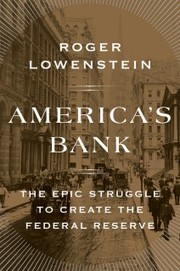
America's Bank: The Epic Struggle to Create the Federal Reserve
How the Federal Reserve was argued into existence, 1907-1913.
Summary
Lowenstein narrates the political creation of the Federal Reserve from the 1907 panic through the Federal Reserve Act of December 1913. The main figures are Senator Nelson Aldrich, whose Jekyll Island meeting produced the initial plan; Paul Warburg, the German-born banker who supplied the technical design from European central banking practice; Carter Glass, the Virginia congressman who wrote the House version; and Woodrow Wilson, who resolved the political deadlock.
The substance is the political constraint. Americans had rejected two previous central banks and the opposition combined agrarian populists who saw any central institution as a Wall Street instrument with bankers who did not want government control. The compromise was structural: twelve regional reserve banks owned by member banks, a Washington board appointed by the president, and a division of powers designed so that neither New York bankers nor the federal government could control it alone. Lowenstein shows this was a political settlement rather than a monetary design, and that the resulting fragmentation of authority was intentional.
He makes the connection to later performance explicit: the division of authority between regional banks and the board, which was the price of passage, contributed directly to the paralysis of 1930 to 1933 when no one had clear responsibility to act.
The book is well-reported narrative history for a general audience. It is light on monetary economics and on the technical questions of note issue, reserve requirements and the gold standard constraint, which readers wanting the monetary history should get elsewhere.
Key takeaways 7
- The Federal Reserve's regional structure was a political compromise designed so that neither New York banks nor the federal government could control it alone.
- The United States had rejected two previous central banks, and the political opposition combined agrarian populists with bankers who each feared control by the other.
- Paul Warburg supplied the technical design from European central banking practice, and the American institution was built on precedents its opponents would have rejected if named.
- The 1907 panic created the political opening, and the reform took six years of negotiation after it.
- The deliberate fragmentation of authority between regional banks and the Washington board removed clear responsibility for acting in a crisis.
- That same fragmentation contributed directly to the paralysis of 1930 to 1933, when no part of the system had unambiguous authority to intervene.
- Founding institutional compromises constrain what an institution can do decades later, long after the political conflict that produced them is forgotten.
Who should read it
Investors and policy readers who want the political origin of the Federal Reserve's structure and why that structure mattered in 1930.
About Roger Lowenstein
Financial journalist and author; Wall Street Journal reporter for over a decade
Buffett: The Making of an American Capitalist and When Genius Failed are the standard reference accounts of Buffett's rise and of the LTCM collapse.
Where it sits in the reference 3
Who recommended it 1
Similar books 6
Chosen by shared topics, the entries that hold them, and the people who recommended both.