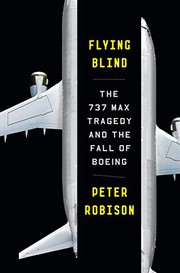
Flying Blind: The 737 MAX Tragedy and the Fall of Boeing
The standard account of the culture shift behind the MAX crashes.
Summary
Robison, a Bloomberg journalist who had covered Boeing for years, wrote about the two 737 MAX crashes that killed three hundred and forty-six people and about the corporate history that produced them.
The technical explanation is clear. Boeing needed to compete with the Airbus A320neo without the cost and the certification delay of a new aircraft, so it fitted larger, more efficient engines to the existing 737 airframe. The engines had to be mounted further forward and higher, which changed the aircraft's pitch behaviour under certain conditions. Boeing added software, the Manoeuvring Characteristics Augmentation System, to counteract this. The system relied on a single angle of attack sensor with no redundancy, could repeatedly command the nose down, and was not described in the pilot manuals or in the training, because a requirement for simulator training would have removed the commercial advantage of an aircraft that pilots could fly without retraining.
The corporate explanation is the book's argument. Robison traces the change after the 1997 McDonnell Douglas merger: the headquarters move to Chicago away from the engineering base, the ascendancy of executives from a financially driven culture, the emphasis on share buybacks and shareholder returns, the pressure on suppliers and on engineering costs, the outsourcing that had already caused the 787's delays, and the relationship with the Federal Aviation Administration under which Boeing employees performed certification work on the regulator's behalf.
Robison's reporting includes internal messages in which employees described the aircraft and the process in damning terms.
The book argues a position and Boeing disputes elements of it. The technical account is consistent with the official investigations. The causal claim connecting the merger's cultural change to the specific engineering decisions is an interpretation, though a widely shared one.
Key takeaways 7
- Fitting larger engines to the existing 737 airframe changed the aircraft's pitch behaviour, which software was added to counteract.
- The augmentation system relied on a single sensor with no redundancy and could repeatedly command the nose down.
- The system was omitted from pilot manuals and training because requiring simulator training would have removed the aircraft's commercial advantage.
- Avoiding a requirement for pilot retraining was the commercial objective that determined the engineering and disclosure decisions.
- Boeing employees performed certification work on the regulator's behalf, which removed independent scrutiny of the design.
- The culture change after the McDonnell Douglas merger shifted authority from engineering toward financial management.
- Internal messages show employees identified the problems and the pressure that produced them before the crashes occurred.
Who should read it
Operators and directors in safety-critical industries who need a documented case of how commercial constraints determined engineering and disclosure decisions.
Where it sits in the reference 2
Similar books 6
Chosen by shared topics, the entries that hold them, and the people who recommended both.