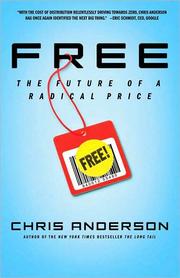
Free
Cross-subsidy and zero marginal cost; the popular case for free tiers.
Summary
Anderson, then editor of Wired, argues that the marginal cost of storage, bandwidth and processing has fallen so close to zero that digital goods can be given away, and that this changes the economics of entire industries rather than being a promotional tactic.
His analytical contribution is a taxonomy of free. Direct cross-subsidies give one product away to sell another. Three-party markets have advertisers pay so that content can be free to consumers, which is the model of broadcast media and search. Freemium offers a basic product free to a large user base and charges a small fraction for a premium version, and Anderson emphasises that the free-to-paying ratio can be extreme because the marginal cost of serving the free users approaches nothing. Non-monetary markets exchange attention, reputation or labour rather than money, which covers open source and user-generated content.
He distinguishes this from the twentieth century's free, where the giveaway was funded by an immediate cross-subsidy, and argues that abundance rather than scarcity should now be the default assumption in digital businesses. He also argues that when a resource becomes abundant, value migrates to whatever remains scarce, which in an attention economy means time, reputation and curation.
The book attracted substantial criticism. Malcolm Gladwell's review argued that the model does not apply where marginal costs are not zero and that many of the businesses Anderson praised had no route to profitability, which subsequent failures largely confirmed. Portions of the text were found to have been taken from Wikipedia without attribution, which damaged the book's standing. The argument also proved incomplete in an important way: what actually happened is that free services funded by advertising concentrated market power in a small number of platforms and made surveillance the price of the free product, which Anderson does not anticipate.
Key takeaways 7
- Marginal costs of digital storage, bandwidth and processing approach zero, so pricing at cost means pricing at zero.
- Free comes in distinct forms, and confusing a cross-subsidy with an advertising model or a freemium model produces the wrong business design.
- Freemium works because serving free users costs almost nothing, so conversion rates in low single digits can still support the business.
- When a resource becomes abundant, economic value moves to whatever adjacent resource remains scarce.
- Attention and reputation function as currencies in markets where money does not change hands.
- Charging zero rather than a very low price changes demand disproportionately, because zero removes the decision rather than lowering its cost.
- Businesses with non-zero marginal costs cannot apply this model, and treating free as a general strategy destroys them.
Who should read it
Founders designing pricing for digital products who want the taxonomy of free models, read against the evidence of which ones actually produced profitable businesses.
About Chris Anderson
Former editor-in-chief of Wired and founder of 3D Robotics; wrote The Long Tail, Free and Makers.
The Long Tail set out how cheap distribution and good search move demand away from a few hits toward a very large catalogue of niche titles, and Free traced what happens to pricing when marginal cost falls to near zero. Both arguments sit underneath how operators and investors size demand in aggregator, marketplace and freemium businesses.
Where it sits in the reference 3
Similar books 6
Chosen by shared topics, the entries that hold them, and the people who recommended both.

