Getting to Yes
Principled negotiation and BATNA; the field's standard vocabulary.
Summary
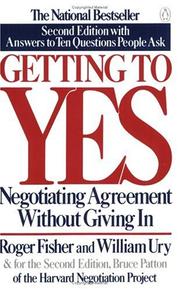
Fisher and Ury present principled negotiation, developed at the Harvard Negotiation Project, as an alternative to positional bargaining in which parties state positions and converge through concessions. Their argument is that positional bargaining produces worse agreements, damages relationships and becomes less efficient as more parties are involved.
The method has four elements. Separate the people from the problem, which requires addressing perception, emotion and communication as a distinct track from the substance. Focus on interests rather than positions, since a position is one way of satisfying an interest and there are usually others, which is illustrated by the two people wanting the same orange for different parts of it. Invent options for mutual gain before deciding, which requires separating the generation of options from their evaluation. Insist on objective criteria, meaning that agreement should rest on standards independent of either side's will, such as market value, precedent or professional standards.
The most used concept is BATNA, the best alternative to a negotiated agreement, which they identify as the source of negotiating power. A party should know their own alternative, improve it where possible, and estimate the other side's. They also cover negotiation jujitsu for dealing with a party who will not engage, and the one-text procedure for multiparty situations.
Voss's Never Split the Difference is written explicitly against this book, arguing that it assumes rational counterparties. The framework works best where both sides want an agreement and have ongoing relationships, and works poorly against people negotiating in bad faith. The BATNA concept and the interests-versus-positions distinction have entered general practice.
Key takeaways 8
- Positional bargaining produces worse agreements and damages relationships, because concessions become the currency rather than the substance.
- Interests are the reasons behind stated positions, and multiple positions can usually satisfy the same interest.
- The people and the problem should be handled on separate tracks, since attacking the problem while attacking the person produces defence rather than agreement.
- Options should be generated before any of them is evaluated, because judgment during generation suppresses the alternatives that would have helped.
- Agreement should rest on criteria independent of either side's will, such as market value, precedent or professional standards.
- Negotiating power comes from the quality of your best alternative to an agreement, not from resources, size or aggression.
- Improving your alternative before the negotiation changes the outcome more than any technique used during it.
- The method assumes counterparties who want an agreement, and works poorly against those negotiating in bad faith.
Who should read it
Anyone negotiating with counterparties they will deal with again, wanting the interests framework and the discipline of establishing alternatives first.
Where it sits in the reference 1
Who recommended it 6 · 2 direct
Similar books 6
Chosen by shared topics, the entries that hold them, and the people who recommended both.