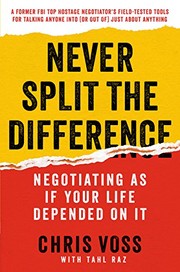
Never Split the Difference
Insider account from FBI hostage negotiation, applied commercially.
Summary
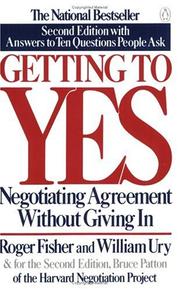
Voss was the FBI's lead international kidnapping negotiator and argues that the negotiation methods taught in business schools, particularly the rational problem-solving approach in Getting to Yes, fail against people acting under emotion and uncertainty. His alternative treats negotiation as applied psychology aimed at understanding and influencing the other side's emotional state.
The techniques are specific and named. Tactical empathy means articulating the other side's perspective explicitly. Labelling means naming their emotion aloud, prefixed with phrases like it seems that, which defuses negative feelings by making them explicit. Mirroring means repeating the last three words they said, which produces elaboration without a question. The accusation audit means listing every negative thing they could say about you before they say it. Calibrated questions beginning with how or what transfer the problem to them and produce what Voss calls the illusion of control.
His most contrarian argument concerns no rather than yes. He holds that yes is frequently a commitment people give to end the pressure, that no makes people feel safe and in control, and that the objective is that's right, meaning the moment the other side confirms you have understood them. He rejects compromise, arguing that splitting the difference produces outcomes that satisfy nobody, and he covers the Ackerman bargaining system for price negotiation with specific percentages.
The evidence is Voss's own cases and his consulting practice rather than research, and hostage negotiation differs from commercial negotiation in that the parties have no ongoing relationship and no alternatives. The techniques work in practice and readers report success with them, and they can read as manipulative when applied without the underlying attention.
Key takeaways 8
- Negotiation is applied psychology aimed at the other side's emotional state, not a rational problem-solving exercise between two calculating parties.
- Naming the other side's emotion explicitly reduces its intensity, while ignoring it allows it to govern their behaviour.
- Repeating the last few words the other person said produces elaboration and additional information without asking a question.
- No makes people feel safe and in control, while yes is often given to end pressure and carries no commitment.
- The objective is hearing that's right from the other side, which confirms you have understood their position, and which is different from hearing you're right.
- Listing their likely objections before they raise them removes the force of those objections and establishes that you understand their position.
- Calibrated questions starting with how or what transfer the problem to the other side and get them to solve it for you.
- Splitting the difference produces an outcome that satisfies neither party, and the willingness to reach no deal is what makes a good deal possible.
Who should read it
Founders and operators negotiating with counterparties whose behaviour is driven by emotion and uncertainty rather than by clean interest calculation.
Where it sits in the reference 1
Who recommended it 8 · 4 direct
Similar books 6
Chosen by shared topics, the entries that hold them, and the people who recommended both.