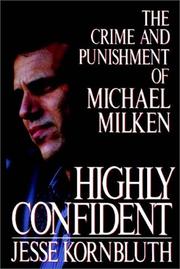
Highly Confident: The Crime and Punishment of Michael Milken
Sympathetic; written with access to Milken's circle.
Summary
Kornbluth, a magazine journalist, wrote an account of Michael Milken's career and prosecution that is more ambivalent than either the hostile or the defensive treatments. The title refers to the highly confident letter, Drexel's innovation of stating that it was highly confident it could raise financing for a bid, which functioned as commitment without being one and which changed the balance of power in hostile takeovers.
The reporting covers Milken's development of the high-yield market from his student work on Braddock Hickman's default studies, the argument that below-investment-grade bonds had been priced to yield more than their default experience justified, the building of a buyer network, and the extension from fallen angels to original-issue high-yield debt used to finance acquisitions and leveraged buyouts. Kornbluth takes the financial innovation seriously rather than dismissing it.
On the prosecution he is more critical. He documents the pressure applied to Drexel through the threat of a racketeering indictment, which would have frozen the firm's capital and destroyed it before trial, and the resulting decision to settle and to cooperate against Milken. He notes that the six counts to which Milken eventually pleaded were technical securities violations rather than the insider trading and manipulation that the public associated with the case, and that the sentence was reduced substantially after cooperation.
Kornbluth also examines what Milken personally extracted, particularly the equity warrants and partnership interests that accompanied issues, which he treats as the strongest evidence of self-dealing.
The book is journalism written during the aftermath, and readers should compare it with Stein's hostile account and Fischel's defence, both also in this reference. Its balance is its value; its weakness is that it does not resolve the question it raises about whether the innovation and the misconduct were separable.
Key takeaways 7
- Milken's original thesis came from default studies showing that below-investment-grade bonds yielded more than their realised loss experience justified.
- The highly confident letter let Drexel back hostile bids with a statement that carried the force of commitment without the legal obligation.
- High-yield financing gave bidders without capital the ability to attack much larger public companies, which changed corporate control everywhere.
- The threat of a racketeering indictment would have destroyed Drexel before trial, which is why the firm settled and cooperated.
- The counts Milken pleaded to were technical securities violations rather than the insider trading the case was publicly understood to concern.
- Equity warrants and side partnerships taken alongside underwritings transferred value to Milken personally rather than to his firm.
- A market dominated by one dealer produces prices and liquidity that depend on that dealer continuing to operate.
Who should read it
Readers wanting a balanced account of the Milken case that takes both the financial innovation and the prosecution's overreach seriously.
Where it sits in the reference 3
Similar books 6
Chosen by shared topics, the entries that hold them, and the people who recommended both.