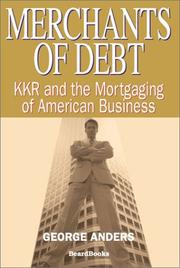
Merchants of Debt: KKR and the Mortgaging of American Business
The best firm-level account of the buyout method.
Summary
Anders, a Wall Street Journal reporter, wrote a critical history of Kohlberg Kravis Roberts from the 1976 founding through the aftermath of the RJR Nabisco buyout. He had substantial access to the firm and to the companies it owned.
The institutional material covers how the buyout worked in practice: the identification of companies with stable cash flow and undervalued assets, the assembly of debt financing first from banks and then from the high yield market, the equity contribution which was a small fraction of the purchase price, the fee structure through which KKR earned transaction fees, monitoring fees and carried interest, and the management incentive arrangements that made executives wealthy.
Anders' critical argument concerns where the value came from. He documents specific transactions where returns depended on interest deductibility, on asset sales, on cutting research and capital investment, and on wage and pension changes rather than on operating improvement, and he follows the consequences at companies including Safeway, where the reorganisation involved substantial job losses that he reports in detail.
He also covers the fee economics closely, showing that KKR's partners earned enormous sums from transaction and monitoring fees regardless of investment outcomes, which is a structural point that applies to the industry generally.
The book is adversarial where Baker and Smith's academic treatment is sympathetic, and reading both gives a fuller picture. Anders is a careful reporter and the transaction detail is accurate. It ends in 1992 and predates the industry's later development entirely.
Key takeaways 7
- KKR's partners earned very large sums from transaction and monitoring fees regardless of whether the underlying investments succeeded.
- A substantial share of buyout returns came from interest deductibility, asset sales and reduced investment rather than from operating improvement.
- The equity contribution in early leveraged buyouts was a small fraction of the purchase price, which magnified returns and transferred risk to lenders.
- Management incentive arrangements made executives wealthy from transactions that imposed costs on employees and on the business's long-horizon capacity.
- Cutting research and capital investment raises near-term cash flow and is invisible in the financial statements until years later.
- The buyout firm's economics reward doing deals rather than doing good deals, which is a structural feature of the fee arrangement.
- Debt service obligations forced asset sales and cost reductions on schedules determined by the financing rather than by the business.
Who should read it
Investors and operators who want the critical account of leveraged buyout economics and fee structures, read alongside the academic defence.
Where it sits in the reference 4
Similar books 6
Chosen by shared topics, the entries that hold them, and the people who recommended both.