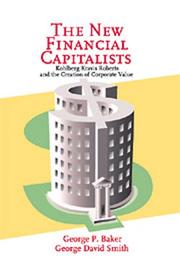
The New Financial Capitalists: Kohlberg Kravis Roberts and the Creation of Corporate Value
Academic and broadly favorable.
Summary
Baker and Smith, academics who had access to KKR's records and partners, examine the firm as an organisational innovation rather than as a set of transactions. Their argument is that the leveraged buyout partnership solved the agency problems of the diversified public corporation more effectively than any internal governance reform did.
The mechanism they identify has three parts working together. High leverage imposes a fixed obligation on cash flow, which removes management's discretion to reinvest in low-return projects and forces the disposal of assets that do not earn their cost of capital. Concentrated equity ownership by management, at meaningful multiples of their net worth, aligns their interests with the value of the equity rather than with the size of the company. And an active board with a small number of members who own the company and understand it replaces a large diffuse board with no ownership stake.
They use KKR's own record, including Houdaille, Beatrice, Safeway and RJR Nabisco, and they analyse the returns to determine how much came from leverage, from multiple expansion, from asset sales and from operating improvement.
The book is academic and it accepts the Jensen free cash flow framework as its starting point, which readers should recognise as a position rather than a finding. It is sympathetic to the buyout form and the treatment of the employment and community consequences is thin. It was written in 1998 and predates the industry's transformation into diversified asset management.
Key takeaways 7
- The leveraged buyout partnership was an organisational innovation that solved the agency problems of the diversified public corporation more effectively than internal governance reform.
- High leverage removes management discretion over free cash flow, which forces the disposal of assets that do not earn their cost of capital.
- Concentrated management equity ownership at meaningful multiples of personal net worth aligns incentives in a way that stock options at public companies do not.
- Small active boards whose members own the company and understand its operations supply governance that large diffuse public boards cannot.
- KKR's returns came from a combination of leverage, multiple expansion, asset disposal and operating improvement, and the mix differed substantially between deals.
- The buyout firm functions as a new kind of financial intermediary, holding concentrated positions with control rather than diversified positions without it.
- Debt is a governance instrument rather than only a financing choice, because the obligation to service it constrains decisions that no policy could constrain.
Who should read it
Investors and directors interested in the governance argument for leveraged ownership and in a documented analysis of where buyout returns came from.
Where it sits in the reference 3
Who recommended it 1 · 1 direct
Similar books 6
Chosen by shared topics, the entries that hold them, and the people who recommended both.