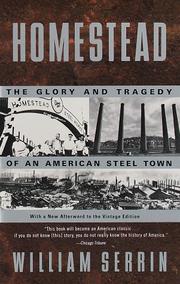
Homestead: The Glory and Tragedy of an American Steel Town
A century of the town Carnegie built and broke.
Summary
William Serrin, a former New York Times labour correspondent, traces a single Pennsylvania mill town from Andrew Carnegie's purchase of the works in 1883 to the day USX shut the plant down in 1986. The 1892 lockout and the gun battle with Pinkerton agents occupy the centre of the book, but Serrin treats that defeat as the start of a ninety-year story rather than its climax. He follows what happened after the Amalgamated Association was broken: twelve-hour days, immigrant labour recruited to divide the workforce, the union's return under the CIO in the late 1930s, the postwar wage settlements, and the slow managerial decision to stop reinvesting in the mill.
The evidence comes from company records, union archives, local newspapers and several hundred interviews with Homestead residents. Serrin knows the town at street level and uses that access to complicate both of the standard stories. He rejects the corporate account in which foreign competition alone killed American steel, and he is equally hard on the United Steelworkers, arguing that the union traded work rules and technological modernisation for wage gains and then had nothing to defend when the orders stopped.
For an investor or operator the book is a long case study in capital allocation inside a mature industry. Serrin documents how U.S. Steel diverted cash from the mills into acquisitions, most conspicuously the purchase of Marathon Oil in 1981, while Homestead's furnaces aged. The book is journalistic rather than quantitative, and readers wanting comparative productivity data on American versus Japanese steelmaking will need to go elsewhere. Its account of the 1892 events has been supplemented by later scholarship, though not overturned.
Key takeaways 7
- Carnegie built his cost advantage on continuous reinvestment and on driving labour costs down, and the two policies were deliberately linked.
- The 1892 defeat at Homestead removed unions from the American steel industry for roughly forty-five years.
- U.S. Steel operated as a price-stabilising combination after 1901 and lost the technical aggressiveness Carnegie's firm had shown.
- The union's postwar bargaining strategy secured high wages while conceding management's right to underinvest in plant.
- U.S. Steel's purchase of Marathon Oil in 1981 revealed that management no longer believed steel deserved its own capital.
- Foreign competition explains part of the industry's collapse but arrived after decades of deferred domestic modernisation.
- Company towns generate loyalty that survives the company, which is why Homestead's residents defended an employer that had already left.
Who should read it
Investors and operators who want a ground-level history of how a dominant industrial franchise decays over decades of capital-allocation choices rather than in a single competitive shock.
Where it sits in the reference 2
Similar books 6
Chosen by shared topics, the entries that hold them, and the people who recommended both.