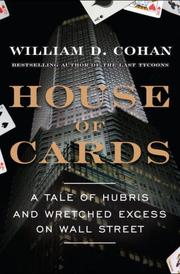
House of Cards: A Tale of Hubris and Wretched Excess on Wall Street
Summary
Cohan opens with the ten days in March 2008 during which Bear Stearns went from apparently solvent to sold, reconstructing them hour by hour from interviews with the participants, then goes back to build the firm's history from Salim Lewis through Alan Greenberg to Jimmy Cayne.
The collapse mechanism is the substance. Bear funded long-dated illiquid mortgage assets with overnight repurchase agreements. When counterparties began refusing to roll that funding and hedge funds pulled prime brokerage balances, the firm ran out of cash in days despite reporting adequate capital. Cohan documents the failure of the two Bear-sponsored hedge funds in mid-2007 as the event that started the loss of confidence, the effect of rumour and CNBC coverage, the Federal Reserve's decision to lend through JPMorgan, and the negotiation that moved the price from two dollars to ten.
Cohan is a former banker and the financial detail is accurate. The book is the best single account of a modern liquidity run on a broker-dealer, and its use to investors is showing that a solvency assessment based on reported capital tells you nothing about survival when funding is overnight and unsecured by reputation. The cultural material on Cayne, including the bridge tournaments and the golf, is well reported but Cohan gives it more causal weight than it can carry. The book also treats Bear as a special case, when the same funding structure existed across the industry and the difference was largely which firm lost confidence first.
Key takeaways 7
- Bear Stearns failed because it financed illiquid long-dated assets with overnight repurchase agreements, and no level of reported capital could survive counterparties refusing to roll that funding.
- A broker-dealer's solvency is irrelevant to its survival once clients and counterparties decide to withdraw, since the run happens faster than assets can be sold.
- The failure of the two Bear-sponsored mortgage hedge funds in 2007 destroyed the firm's credibility with counterparties nine months before the collapse.
- Prime brokerage balances are the most fragile funding a broker-dealer has, because hedge fund clients move first and move fully.
- Bear's refusal to participate in the 1998 Long-Term Capital Management rescue cost it goodwill that mattered when it needed help.
- The Federal Reserve's intervention was structured through JPMorgan because the Fed had no legal mechanism to lend directly to an investment bank.
- Every major broker-dealer used the same funding structure, so the question of which firm failed first was determined by confidence rather than by balance sheet quality.
Who should read it
Investors and risk managers who want a detailed account of how a funding run kills an apparently solvent institution in days.
About William D. Cohan
Financial journalist and former investment banker at Lazard, Merrill Lynch and JPMorgan Chase.
House of Cards reconstructs the ten days in which Bear Stearns lost its funding, hour by hour and from the people in the room, and remains the closest study of how a broker-dealer run actually proceeds. Money and Power and The Last Tycoons trace how Goldman Sachs and Lazard made money over decades, including the partnership economics and internal politics that decided who got paid.
Where it sits in the reference 4
Who recommended it 1 · 1 direct
Similar books 6
Chosen by shared topics, the entries that hold them, and the people who recommended both.