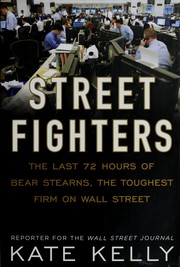
Street Fighters: The Last 72 Hours of Bear Stearns
Summary
Kate Kelly covered Bear Stearns for the Wall Street Journal and reconstructed the firm's final days in March 2008 from interviews with participants. The book is a close narrative of a short period rather than a history of the firm.
The sequence she documents runs from the Tuesday when rumours about Bear's liquidity began circulating, through the withdrawal of repo funding and of prime brokerage balances, the Thursday night realisation that the firm would not open on Monday, the emergency Federal Reserve lending arranged through JPMorgan on Friday, the weekend negotiation, and the initial agreement at two dollars a share that was renegotiated to ten after shareholder revolt. She covers the personalities: James Cayne, who was at a bridge tournament during part of the week, Alan Schwartz, who had recently become chief executive, and the JPMorgan and Federal Reserve officials involved.
Kelly's account is journalistic and does not attempt to analyse whether Bear was solvent or merely illiquid, which is the substantive question. She also relies heavily on participants' recollections shortly after the events, with the reliability problems that implies. The value of the book is the detail on how quickly a securities firm's funding disappears once counterparties begin withdrawing, and on the mechanics of a weekend rescue negotiation. It should be read alongside accounts that address the underlying balance sheet.
Key takeaways 7
- Bear Stearns lost most of its liquidity within three days once counterparties began withdrawing repo funding and prime brokerage balances.
- A securities firm dependent on overnight secured funding cannot survive a loss of confidence regardless of its asset quality.
- Prime brokerage clients moving balances were as damaging as repo lenders withdrawing, because both were unsecured in practice.
- The initial two dollar price reflected the Federal Reserve's insistence that shareholders not benefit from the rescue.
- Shareholder revolt forced renegotiation to ten dollars, which demonstrated that the original terms were not enforceable.
- Kelly documents that senior management did not believe the firm was in danger until days before it failed.
- The rescue required a solvent acquirer with a balance sheet large enough to absorb the positions, which limited the available options to one.
Who should read it
Investors and risk managers who want a detailed reconstruction of how quickly a wholesale-funded securities firm loses its funding.
Where it sits in the reference 2
Similar books 6
Chosen by shared topics, the entries that hold them, and the people who recommended both.