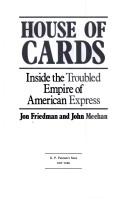
House of Cards: Inside the Troubled Empire of American Express
The Robinson years, Shearson, and the boardroom unravelling.
Summary
Jon Friedman and John Meehan report on American Express under James Robinson III, covering roughly 1977 to 1992. The company set out to build a financial supermarket, acquiring Shearson, then Lehman Brothers, then E.F. Hutton, alongside insurance and banking operations. The authors argue that the strategy failed because the acquired businesses had incompatible cultures and compensation structures, and because Amex management never established what the combined firm was supposed to do better than its parts.
The most damaging episode the book reports is the campaign against Edmond Safra, the banker who had sold Trade Development Bank to American Express and then competed with it. Amex executives helped place false stories in the press linking Safra to drug trafficking and organised crime. Robinson eventually apologised publicly and the company paid $8 million to charities Safra named. The authors use the affair to argue that the company's public reputation for probity concealed a management culture organised around image protection.
The reporting rests on interviews with executives and on contemporaneous documents; it is journalism written close to events and without the later archival record. Readers should note that it stops before the outcome, which included Robinson's removal in early 1993, Harvey Golub's turnaround and the spin-off of Lehman. Anyone studying financial conglomerates will find the diagnosis useful and the ending incomplete.
Key takeaways 6
- American Express assembled a financial supermarket without ever identifying a cost or revenue synergy that customers would pay for.
- Investment banking compensation norms are incompatible with those of a consumer brand company, and merging the two destroys retention in the bank.
- Robinson's management prized external reputation to the point of authorising a smear campaign against a private competitor.
- The core card business subsidised acquisitions that never earned their cost of capital.
- Shearson's serial acquisitions bought market share and legacy liabilities rather than durable advantage.
- Boards populated by chief executives of other large companies gave Robinson years of support that operating results did not justify.
Who should read it
Investors and directors examining why financial-services roll-ups usually fail to deliver the synergies their sponsors promise.
Where it sits in the reference 2
Similar books 6
Chosen by shared topics, the entries that hold them, and the people who recommended both.