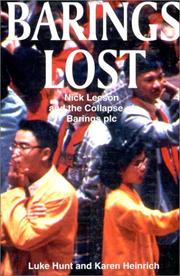
Barings Lost: Nick Leeson and the Collapse of Barings Plc
Reported from Singapore.
Summary
The reference has not verified this book in detail; the summary states only what the title, author and subject establish.
Hunt and Heinrich, journalists based in Southeast Asia, wrote an account of the Barings collapse from the Singapore end, where the trading took place and where Leeson operated.
The reference has not verified the book's detailed contents beyond the established facts of the case. Those facts are that Leeson ran Barings Futures Singapore with responsibility for both trading and the back office, that he concealed losses in an error account excluded from reports to London, that he reported profits from what was described as low-risk arbitrage between the Singapore and Osaka exchanges while actually holding a large directional position including short options on the Nikkei, that the Kobe earthquake in January 1995 moved the market against him, that London continued funding margin calls exceeding the bank's capital without establishing what positions required them, and that the bank collapsed in February 1995 and was sold to ING for one pound.
A Singapore-based account would have particular material on the local regulatory position, the Singapore International Monetary Exchange's own monitoring of the position sizes, which were visible to the exchange, the Singapore inspectors' report which was critical of Barings management, and Leeson's arrest in Frankfurt and extradition to Singapore where he served his sentence.
Gapper and Denton's All That Glitters, also in this reference, is the more widely cited account and covers the London management failures more thoroughly. Readers wanting the Singapore regulatory and legal dimension may find this the more relevant source.
Key takeaways 7
- Leeson controlled both trading and settlement, which allowed him to conceal losses in an account excluded from reporting.
- The reported profits were implausible for the arbitrage strategy claimed and were not investigated.
- The Singapore exchange could see the position sizes, which were large relative to the market, without acting on them.
- London funded margin calls exceeding the bank's entire capital without establishing what positions required the money.
- The Kobe earthquake moved the Nikkei against a short volatility position that had already been accumulating losses.
- Singapore's inspectors were critical of Barings management rather than treating the collapse as one individual's fraud.
- The bank was sold to ING for a nominal sum, which ended two centuries of independent existence.
Who should read it
Readers wanting the Singapore perspective on the Barings collapse, with Gapper and Denton's account for the London management failures.
Where it sits in the reference 2
Similar books 6
Chosen by shared topics, the entries that hold them, and the people who recommended both.