Rogue Trader
Insider: the trader's own account, written from prison.
Summary
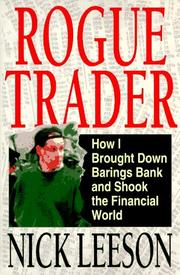
Nick Leeson worked in Barings Bank's Singapore operation and lost roughly 827 million pounds, which destroyed a bank that had operated since 1762. He wrote this from prison in Germany and Singapore, with Edward Whitley.
The operational account is the useful part. Leeson describes how he came to control both the trading and the settlement functions in Singapore, which meant he could book trades and also record their outcomes. He describes the 88888 error account, originally opened to handle a subordinate's mistake, and how he used it to conceal losses. He describes the trading that produced them: initially arbitrage between the Nikkei futures contracts on the Singapore and Osaka exchanges, then increasingly directional positions, and finally an enormous short straddle position on the Nikkei that was destroyed by the Kobe earthquake in January 1995. He describes fabricating a receivable from a customer to cover a margin call, and the funds London sent him without understanding what they were funding.
Leeson is self-justifying and the reader should discount accordingly; he presents Barings management as negligent and himself as swept along, and the Bank of England's report and the subsequent inquiries were considerably harder on him. What is not disputed is the control failure: no bank should let one person both trade and settle, and Barings' management could not explain what business generated the profits Leeson reported. The book is worth reading alongside the Bank of England report and Stephen Fay's account.
Key takeaways 7
- Leeson controlled both trading and settlement in Singapore, which is the single control failure that made everything else possible.
- Losses were concealed in an error account that management could see and never examined.
- Barings' management could not explain what strategy produced the profits Leeson reported, and did not ask.
- An arbitrage strategy that reports large profits is not arbitrage, since genuine arbitrage produces small returns on large volume.
- Leeson's final position was a short volatility straddle on the Nikkei, which the Kobe earthquake destroyed.
- London sent funds to meet margin calls without establishing whose positions were being margined.
- Leeson's account is self-serving, and the official inquiries assigned him considerably more responsibility than he assigns himself.
Who should read it
Risk and control professionals who want the insider account of the segregation-of-duties failure that remains the standard teaching case.
Where it sits in the reference 2
Similar books 6
Chosen by shared topics, the entries that hold them, and the people who recommended both.