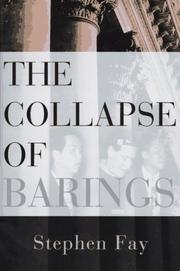
The Collapse of Barings
The best-reported outside account.
Summary
Stephen Fay, a British financial journalist, wrote this account of the destruction of Barings Bank in February 1995 by losses in its Singapore futures operation. It covers both the trading and the institutional failure, with more attention to the bank than Nick Leeson's own account gives.
Fay reconstructs Barings as an institution: an old merchant bank owned by a charitable foundation, run by a management that had recently expanded into securities trading in Asia without building the controls that business required. He documents the reporting lines, which left it unclear who supervised Leeson, the settlements function that Leeson controlled alongside his trading, the funding requests London met without understanding, and the internal audit report that identified the control problem and produced no action.
He also covers the final days: the discovery of the losses, the attempt to find a buyer over the weekend, the Bank of England's decision not to organise a rescue, and the sale to ING for one pound. Fay's argument is that the bank was destroyed by its management rather than by Leeson, who could not have acted as he did in an institution with ordinary controls. The book is well reported and is the better account of the institutional side, complementing Leeson's memoir and Helga Drummond's organisational study.
Key takeaways 7
- Barings expanded into Asian derivatives trading without building the control functions that business requires.
- Leeson controlled both trading and settlement, and no institution with ordinary segregation of duties could have suffered this loss.
- Reporting lines were unclear enough that no manager considered himself responsible for supervising the Singapore operation.
- London funded margin calls in amounts it could not explain, which means the treasury function did not know what it was financing.
- An internal audit report identified the control failure and produced no change.
- The Bank of England declined to organise a rescue, which established that a merchant bank of this size was not systemically important.
- Fay argues that the bank was destroyed by management failure rather than by a single trader's actions.
Who should read it
Risk and governance professionals who want the institutional account of the Barings failure rather than the trader's version.
Where it sits in the reference 2
Similar books 6
Chosen by shared topics, the entries that hold them, and the people who recommended both.