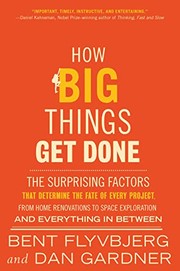
How Big Things Get Done
Why megaprojects overrun, and the reference-class forecasting correction.
Summary
Flyvbjerg has assembled a database of more than sixteen thousand large projects across twenty-plus types and jurisdictions, and this book presents what the data shows about why projects fail and what distinguishes the ones that succeed. Gardner is the co-writer.
The empirical findings are stark. The overwhelming majority of large projects exceed their budgets, run late, or deliver less benefit than promised, and a substantial share do all three. The distribution of cost overruns is fat-tailed rather than normal, which means the average overrun understates the risk badly and a small number of projects run catastrophically over. Some project types, notably nuclear plants, Olympic Games and information technology, have fatter tails than others, while solar, wind, transmission lines and roads are more predictable.
His explanation combines behavioural causes, principally optimism bias and strategic misrepresentation, where promoters deliberately understate costs to get approval, with a structural cause: projects that must be built as one custom item cannot learn, while projects assembled from repeated modular units can.
His prescriptions are specific. Think slow and act fast, meaning spend heavily on planning and simulation while changes are cheap, then build quickly to limit exposure. Use reference class forecasting, meaning base estimates on the distribution of actual outcomes for similar projects rather than on a bottom-up estimate. Build modular where possible. Hire a team with direct experience of the same thing.
The database is the book's strength and the claims are unusually well supported for the genre.
Key takeaways 7
- The overwhelming majority of large projects exceed budget, run late or deliver reduced benefits, and the pattern holds across project types and countries.
- Cost overruns follow a fat-tailed distribution, so the average overrun badly understates the risk and a small number of projects fail catastrophically.
- Projects assembled from repeated modular units are far more predictable than projects built as a single custom item, because repetition allows learning.
- Reference class forecasting, meaning estimating from the distribution of actual outcomes for similar projects, outperforms any bottom-up estimate.
- Optimism bias and deliberate understatement of costs to secure approval both operate, and the second is more common than promoters admit.
- Extensive planning and simulation before commitment is cheap, while changes during construction are extremely expensive, which argues for slow planning and fast building.
- Teams with direct prior experience of the identical project type outperform teams assembled for expertise in the abstract.
Who should read it
Anyone commissioning or funding a large project who needs the actual distribution of outcomes and the practices that shift it.
About Dan Gardner
Canadian journalist who co-wrote Superforecasting with Philip Tetlock and How Big Things Get Done with Bent Flyvbjerg.
Superforecasting reports the Good Judgment Project tournament results and the habits that separated accurate forecasters: breaking questions into parts, updating in small increments, keeping score in numbers. How Big Things Get Done adds base-rate evidence from thousands of megaprojects on why budgets and schedules fail and what the successful ones did differently.
Where it sits in the reference 4
Similar books 6
Chosen by shared topics, the entries that hold them, and the people who recommended both.