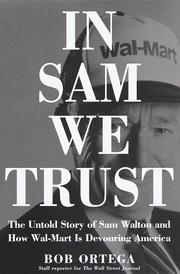
In Sam We Trust
First major critical history by a WSJ Walmart reporter.
Summary
Ortega, a Wall Street Journal reporter who covered Walmart, wrote a critical history of the company and of Sam Walton. It covers the Arkansas beginnings, the distribution system, the growth strategy of saturating rural markets that competitors ignored, the move into supercenters, and the labour and supplier practices that made the low prices possible.
The operational analysis is solid. Ortega explains the hub-and-spoke distribution model, in which stores are placed within a day's drive of a distribution centre and the centre is built before the stores, which gave Walmart a logistics cost advantage competitors could not match without rebuilding their networks. He covers the early adoption of point-of-sale data and satellite communications, and the supplier relationship in which Walmart's scale converted into terms that shifted inventory risk and margin onto manufacturers.
The critical material concerns labour and community effects: wage levels, the classification practices that limited benefits eligibility, the sustained opposition to unionisation, the Buy American campaign that Ortega documents as largely presentational while sourcing shifted overseas, and the effect on the retail base of small towns. He also examines the Walton family's public image against the company's practices.
The book is from 1998 and predates Walmart's international expansion, the grocery dominance, the labour litigation of the 2000s and the competition with Amazon. It is adversarial in tone and readers should expect that. The distribution and data material is what investors and operators will use, and it holds up.
Key takeaways 7
- Walmart built distribution centres before stores and placed stores within a day's drive of them, which produced a logistics cost advantage competitors could not replicate without rebuilding their networks.
- Saturating rural markets that larger chains considered too small gave Walmart scale and a supplier position before any competitor engaged with it.
- Early investment in point-of-sale data and satellite communications gave Walmart better information about demand than its suppliers had about their own products.
- Walmart's scale converted into supplier terms that shifted inventory risk, promotional cost and margin onto manufacturers.
- Low prices depended on labour cost practices including scheduling, classification and sustained opposition to unionisation.
- The Buy American campaign functioned mainly as public positioning while sourcing shifted overseas, which Ortega documents from company records.
- Walton's cultivated image as a modest small-town merchant was managed deliberately and served a commercial purpose.
Who should read it
Retail operators and investors who want the distribution and data strategy analysed alongside a critical account of the labour and supplier practices.
Where it sits in the reference 5
Similar books 6
Chosen by shared topics, the entries that hold them, and the people who recommended both.