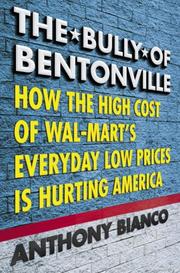
The Bully of Bentonville
Business-press account of supplier and wage pressure.
Summary
Anthony Bianco, a BusinessWeek writer, examines Wal-Mart's effects on workers, suppliers, competitors and communities. The book is critical and organises its reporting around the costs the company imposes on parties other than its customers.
The reporting covers the wage and scheduling practices in stores, the litigation over off-the-clock work and the Dukes sex discrimination class action, the health insurance coverage and the share of employees relying on public programmes, the resistance to unionisation including the closure of a store and a meat department after organising votes, the pressure on suppliers to reduce prices annually and the manufacturing relocation that followed, the effects on independent retailers in towns the company entered, and the political and lobbying activity.
Bianco also covers the company's response, including the McKinsey-informed benefits review, the environmental commitments and the public relations effort. He is a business journalist rather than an activist and the reporting is specific. The book gives limited weight to the consumer surplus Wal-Mart generated, which the academic work suggests is very large and concentrated among lower-income households, and readers should set it against that literature. It was published in 2006, before the company's later wage increases and before Amazon changed the competitive position.
Key takeaways 7
- Wal-Mart's cost advantage rested partly on labour practices whose costs were transferred to workers and to public programmes.
- Annual price reduction demands on suppliers forced manufacturing relocation to lower-cost countries.
- The company closed operations following successful union organising votes, which deterred further attempts.
- Entry into a town reduced independent retail employment while lowering prices for consumers.
- Bianco documents scheduling practices that kept employees below full-time thresholds for benefits eligibility.
- The company's scale gives it enough buying power to determine the cost structure of entire supplier industries.
- The book gives limited weight to the substantial consumer surplus the academic literature attributes to the company.
Who should read it
Investors and operators in retail who want the critical account of how Wal-Mart's cost position was constructed, read alongside the economic literature on its consumer effects.
Where it sits in the reference 2
Similar books 6
Chosen by shared topics, the entries that hold them, and the people who recommended both.