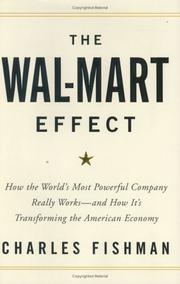
The Wal-Mart Effect
How the buying power reshapes suppliers, prices and wages.
Summary
Fishman, a business journalist, investigated what Wal-Mart's scale actually does to the companies that supply it, to the communities where it operates, and to prices across the economy.
The supplier material is the most original. Fishman documents the relationship from the supplier's side: the annual price reduction expectation, the requirement to open cost structures to Wal-Mart's buyers, the volume that makes a supplier dependent and then makes the terms non-negotiable, and the consequences that follow. He reports cases where suppliers moved production offshore because the price required could not be met domestically, where suppliers redesigned products to lower cost in ways that reduced quality, and where suppliers grew rapidly and then failed when they became too dependent. The Vlasic pickle case, where a gallon jar sold at a price that damaged the entire category's economics, became the standard illustration.
The economic material covers the estimates of consumer savings, which are large, and the studies on local wage and employment effects, which Fishman reports as contested rather than settled. He notes that the price savings and the wage effects are both real and are not measured against each other in any public accounting.
He also covers the difficulty of researching the company, which does not disclose the data that would allow independent assessment, and the effects on fisheries and on production in supplier countries.
The book is reporting rather than economic analysis, and Fishman is careful not to overstate the causal claims. It is from 2006 and the retail environment has changed substantially with Amazon's growth, though the supplier dynamics it describes now apply to platform marketplaces in similar form.
Key takeaways 7
- Wal-Mart expects annual price reductions from suppliers and requires access to their cost structures to verify what is achievable.
- Suppliers that grow to depend on the account lose the ability to negotiate, because losing it would end the business.
- Meeting the required price forced suppliers to move production offshore or to redesign products in ways that reduced quality.
- Selling a product at a price that captures market share can destroy the category's economics for every participant including the supplier.
- Consumer price savings from the company's scale are large and real, and so are the local wage effects, and neither is measured against the other.
- The company does not disclose the data that would permit independent assessment of its economic effects.
- The same supplier dynamics now operate on platform marketplaces, where the intermediary sets terms and holds the customer relationship.
Who should read it
Operators supplying large retailers or platforms, and investors assessing companies with concentrated customer exposure.
Where it sits in the reference 3
Similar books 6
Chosen by shared topics, the entries that hold them, and the people who recommended both.