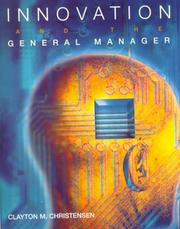
Innovation and the General Manager
Irwin/McGraw-Hill case textbook; Open Library unreachable this run.
Summary
Clayton Christensen assembled this as a teaching volume for a Harvard Business School course, published shortly after The Innovator's Dilemma. It pairs case studies with short conceptual notes, and the structure is that of a course rather than an argument developed across chapters.
The conceptual material covers the disruptive innovation framework, the distinction between sustaining and disruptive technologies, the relationship between value networks and what a firm can perceive as an opportunity, the resource allocation process that determines what actually gets funded regardless of stated strategy, and the question of what organisational structure a given innovation requires. The cases cover disk drives, hydraulic excavators, steel minimills, retailing and several technology firms, many of them the empirical basis for Christensen's published research.
As a book to read rather than to teach from, it is uneven. The notes are compressed statements of arguments Christensen made more fully elsewhere, and the cases assume classroom discussion to yield their point. Its value for a practitioner lies in the resource allocation material, which is the part of Christensen's work most directly usable by an operator and least often summarised. Readers who want the argument rather than the teaching apparatus should read The Innovator's Dilemma instead.
Key takeaways 6
- Resource allocation decisions made below the executive level determine a firm's actual strategy regardless of what senior management announces.
- Established firms fail at disruptive innovation because their best customers do not want the disruptive product.
- A firm's value network determines which performance improvements it can perceive as valuable, and which it will rationally ignore.
- Disruptive innovations initially underperform on the metrics incumbents track and outperform on metrics they do not track.
- The organisational home for an innovation should be chosen by how far it departs from existing processes and values, not by its technical content.
- Managers should match the size of the organisation pursuing an opportunity to the size of the opportunity, because a large unit cannot be motivated by a small market.
Who should read it
Executives and instructors who want Christensen's framework in case-and-note form, particularly the material on how resource allocation overrides stated strategy.
About Clayton Christensen
Kim B. Clark Professor of Business Administration, Harvard Business School 1992-2020; co-founder of Innosight, Rose Park Advisors and the Clayton Christensen Institute; died 23 January 2020
The Innovator's Dilemma turned disruption into a primary framework that the rest of the strategy and innovation literature argues with rather than around.
Where it sits in the reference 2
Similar books 6
Chosen by shared topics, the entries that hold them, and the people who recommended both.