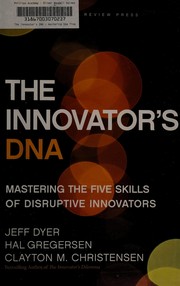
The Innovator's DNA
Open Library unreachable this run; title not machine-verified.
Summary
Jeff Dyer, Hal Gregersen and Clayton Christensen studied innovative entrepreneurs and executives to identify what they do differently, and this book reports the findings. The method combined interviews with several hundred innovators and a survey instrument administered to a much larger population.
They identify five discovery skills. Associating, meaning connecting questions and ideas from unrelated fields, which they treat as the central skill that the other four feed. Questioning, meaning asking why and why not persistently and challenging the assumptions everyone in a field shares. Observing, meaning watching customers and processes closely rather than surveying them. Networking, meaning deliberately seeking out people with different expertise rather than people with similar backgrounds. And experimenting, meaning building and testing rather than analysing.
Their central empirical claim is that these are behaviours rather than traits, that they can be practised and developed, and that innovative organisations institutionalise them through hiring, processes and culture. They report that innovative chief executives spend substantially more time on these activities than their peers. The methodology has the usual problems of research on successful people: the sample is selected on the outcome, self-reported behaviour is unreliable, and the comparison group is not well specified. The behaviours themselves are plausible and the practical exercises are usable. Readers should treat the quantitative claims about how much these skills explain with scepticism.
Key takeaways 7
- Associating, meaning connecting ideas across unrelated fields, is the central discovery skill and the other four supply its inputs.
- Innovators question the assumptions that everyone in their field shares rather than the ones already in dispute.
- Observation of what customers actually do produces insight that surveys and focus groups cannot.
- Deliberately building a network of people with different expertise is a practice rather than a personality characteristic.
- Experimenting means building and testing rather than analysing, which produces information that analysis cannot.
- The authors argue that these are learnable behaviours rather than innate traits, which is the book's central claim.
- The research selects on successful outcomes and relies on self-reported behaviour, which limits how much the quantitative claims establish.
Who should read it
Executives and founders who want specific practicable behaviours associated with innovation, treating the supporting research as suggestive.
About Clayton Christensen
Kim B. Clark Professor of Business Administration, Harvard Business School 1992-2020; co-founder of Innosight, Rose Park Advisors and the Clayton Christensen Institute; died 23 January 2020
The Innovator's Dilemma turned disruption into a primary framework that the rest of the strategy and innovation literature argues with rather than around.
Where it sits in the reference 2
Similar books 6
Chosen by shared topics, the entries that hold them, and the people who recommended both.