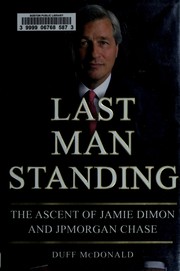
Last Man Standing: The Ascent of Jamie Dimon and JPMorgan Chase
Summary
Duff McDonald wrote this biography of Jamie Dimon with Dimon's cooperation, publishing it in 2009 when Dimon's reputation was at its peak because JPMorgan Chase had come through the crisis better than its competitors. It covers the career from Dimon's start with Sandy Weill at Commercial Credit, through the building of Travelers and its merger with Citicorp, his dismissal in 1998, the Bank One turnaround, the 2004 merger with JPMorgan, and the 2008 acquisitions of Bear Stearns and Washington Mutual.
The operational content concerns Dimon's method, which McDonald presents consistently across three institutions: aggressive cost reduction, insistence on a single technology platform after each merger, detailed personal review of business-line financials, and a preference for holding excess capital. McDonald documents the specific decisions that kept JPMorgan out of the worst subprime exposures, including the 2006 decision to reduce subprime mortgage holdings after reviewing delinquency data, and the maintenance of what Dimon called a fortress balance sheet.
The book is admiring and was written before the London Whale losses in 2012, the mortgage settlements, and the various regulatory penalties that complicated the story. McDonald does not seriously examine whether JPMorgan's crisis performance reflected judgement or the accident of which businesses it happened to be in. Readers should treat it as a well-reported account of a management method, written at the moment of maximum credit to its subject.
Key takeaways 7
- Dimon's method across three institutions was the same: cut costs immediately, consolidate technology onto one platform, and review business-line numbers personally.
- JPMorgan reduced subprime mortgage exposure in 2006 after examining delinquency data that was available to every competitor.
- Holding capital above regulatory minimums cost the bank returns in good years and gave it the option to acquire in 2008.
- Merger integration failures usually originate in retained duplicate technology systems, which is why Dimon treated platform consolidation as the first task.
- Weill and Dimon built Travelers through serial acquisition of undermanaged financial firms bought at low multiples.
- Dimon's dismissal from Citigroup in 1998 was a personal conflict rather than a performance failure, and it gave him Bank One.
- The Bear Stearns and Washington Mutual acquisitions were made possible by capital held for reasons unrelated to those opportunities.
Who should read it
Investors in banks and operators managing serial acquisitions who want a detailed account of one executive's integration and capital discipline.
Where it sits in the reference 2
Similar books 6
Chosen by shared topics, the entries that hold them, and the people who recommended both.