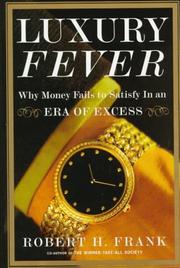
Luxury Fever
The economics of positional goods and status competition.
Summary
Robert Frank, a Cornell economist, argues that a large share of American consumption is positional, meaning that its value depends on comparison with what others have rather than on absolute quantity. He uses this to explain why rising incomes over decades did not raise reported wellbeing, and why spending on housing, cars, weddings and similar visible goods escalated faster than income.
The mechanism is a spending arms race. If the value of a house depends partly on its position relative to other houses in the school district, then everyone buying larger houses leaves everyone in the same relative position while consuming more resources. Frank contrasts positional goods with non-positional ones, principally free time, commuting, job security, and health and safety, whose value does not depend on comparison. He argues that individuals rationally overinvest in the first category and underinvest in the second, and that the aggregate result makes everyone worse off.
His policy proposal is a progressive consumption tax: tax income minus savings, at steeply progressive rates, so that the tax falls on what people spend rather than on what they earn. He argues this would slow the positional arms race without reducing anyone's relative position, and would raise savings and public investment. Critics dispute both the empirical claim that wellbeing has not risen with income and the practicality of the tax, and the happiness research Frank relies on has been contested since, particularly by Stevenson and Wolfers. The positional goods argument itself is now standard in economics.
Key takeaways 7
- A large share of consumption is positional, so its value depends on comparison with others rather than on absolute quantity.
- Spending on positional goods produces an arms race in which everyone consumes more and nobody improves their relative position.
- People systematically underinvest in non-positional goods such as free time, shorter commutes and workplace safety.
- Frank proposes taxing consumption rather than income, at steeply progressive rates, to slow positional spending without changing relative rankings.
- Rising inequality raises positional spending down the income distribution, because reference standards are set by those above.
- Commuting time is the clearest case of a non-positional cost that people accept in exchange for a positional gain in housing.
- Frank argues that the case for redistribution can be made on efficiency grounds alone, without appealing to fairness.
Who should read it
Investors and operators in consumer categories, and anyone thinking about how status competition drives demand, who want the economic argument stated rigorously.
Where it sits in the reference 2
Similar books 6
Chosen by shared topics, the entries that hold them, and the people who recommended both.