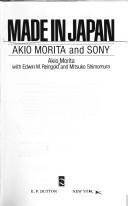
Made in Japan
Insider memoir by Sony's co-founder; a landmark of business writing.
Summary
Akio Morita co-founded Sony with Masaru Ibuka in 1946 and wrote this memoir with Edwin Reingold and Mitsuko Shimomura at the height of the company's success. It covers the company's founding in the ruins of Tokyo, its product decisions, and Morita's account of the differences between Japanese and American business practice.
The product history is the strongest material. Morita describes licensing the transistor from Western Electric over the objections of the Japanese trade ministry, the pocket radio, the Trinitron colour television tube, the Betamax videocassette format and its defeat by VHS, and the Walkman, which he insisted on against internal opposition and market research showing no demand for a tape player without recording capability. He explains his decision to build Sony's own American sales organisation rather than sell through distributors, and to list Sony shares in New York.
The second half sets out Morita's views on management and on the trade conflict of the 1980s. He argues that Japanese firms plan on longer horizons because their shareholders and lenders permit it, that lifetime employment makes labour a fixed cost and therefore makes training worthwhile, and that American executives are financially rather than operationally trained. His criticisms of American short-termism were widely quoted at the time and read differently after Japan's subsequent decades. The book is a chief executive's account and does not examine Sony's failures with any rigour.
Key takeaways 7
- Morita launched the Walkman over internal opposition and against market research, on the argument that customers cannot want a product category that does not exist.
- Sony built its own American sales organisation rather than using distributors, which cost more initially and gave the company direct customer knowledge.
- Licensing the transistor required overcoming Japanese government objection, which Morita presents as evidence that the ministry did not direct Japanese success.
- Betamax lost to VHS because Sony refused to license widely enough, and Morita treats this as his own error.
- Japanese firms treat labour as a fixed cost, which makes investment in training rational in a way it is not where workers leave.
- Morita argues that American managers trained in finance rather than in operations cannot judge what their factories are capable of.
- Selling a product in a foreign market requires understanding the customer directly, which is why Morita moved his family to New York.
Who should read it
Founders and operators in consumer hardware who want a first-hand account of product decisions made against market research and of building direct distribution abroad.
Where it sits in the reference 2
Similar books 6
Chosen by shared topics, the entries that hold them, and the people who recommended both.