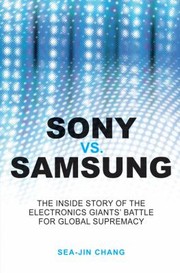
Sony vs Samsung
Strategy comparison explaining how Samsung overtook Sony.
Summary
Chang, a business school professor who has studied Korean and Japanese firms extensively, compares Sony and Samsung Electronics over the period in which Samsung overtook Sony in market value and in most product categories.
His explanation is organisational rather than technological. Sony was built on autonomous business units with strong internal identities, which produced innovation in the analogue era but prevented coordination when digital products required components and software to work together. Chang documents the internal competition that produced incompatible products, the failure to combine hardware with the content businesses Sony had acquired, and the resistance of profitable divisions to cannibalising themselves, which cost Sony the portable music market it had created.
Samsung, by contrast, made large centralised bets on component businesses, particularly memory semiconductors and displays, funded by the chairman's authority against internal and external objection. Chang describes the group's willingness to invest counter-cyclically in memory during downturns, which drove out competitors, and the vertical integration that let the finished-goods businesses use in-house components. He also documents the management practices imported after Lee Kun-hee's 1993 Frankfurt declaration: sending managers abroad for a year, aggressive external recruitment, and design investment.
He is careful about the costs of the Samsung model, including the concentration of authority in the family, the governance problems and the difficulty of innovating outside the categories the centre has selected.
The comparison was written in 2008 and a second edition extended it. Both companies have changed substantially since: Sony recovered through image sensors, gaming and content, while Samsung faced its own succession and governance crises. The organisational analysis remains the useful part.
Key takeaways 7
- Sony's autonomous business units produced innovation in the analogue era and prevented coordination once digital products required integration.
- Sony failed to combine its hardware and content businesses because each division protected its own economics.
- Samsung made large centralised bets on memory semiconductors that no divisional process would have approved.
- Investing counter-cyclically in semiconductor capacity during downturns drove out competitors who could not fund it.
- Vertical integration into components gave Samsung's finished-goods businesses cost and supply advantages competitors lacked.
- Concentrated family authority enabled decisions that professional management structures would have blocked, at the cost of governance quality.
- Divisions with profitable existing products will not cannibalise them, so the decision must come from above or not at all.
Who should read it
Operators and investors in technology hardware who want an organisational explanation of why one incumbent lost a lead and another built one.
Where it sits in the reference 3
Similar books 6
Chosen by shared topics, the entries that hold them, and the people who recommended both.