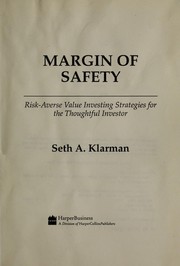
Margin of Safety: Risk-Averse Value Investing Strategies for the Thoughtful Investor
Out of print since the 1990s and never reprinted; used copies trade at collector prices.
Summary
Klarman published this in 1991 and never allowed it to be reprinted, which is why used copies sell for thousands of dollars. He runs the Baupost Group and writes from that practice. The book has three parts: where most investors go wrong, a philosophy of value investing, and the process of implementing it.
The first part is a critique of the institutional investment business. Klarman argues that most professional investors are constrained by relative performance measurement, career risk, benchmark tracking and the need to remain fully invested, all of which produce behaviour that conflicts with returns. He is particularly hard on the sell side, on the junk bond market of the 1980s, and on the willingness of institutions to buy securities they cannot value.
The second part states the position: investors should be absolute-return oriented, should treat risk as the probability of permanent loss rather than as volatility, should hold cash when opportunities are absent, and should demand a substantial discount to conservatively estimated value. Klarman argues that avoiding losses is the necessary condition, because the arithmetic of recovery from large drawdowns is punishing.
The third part covers where he finds opportunities, including bankruptcies and reorganisations, corporate liquidations, spinoffs, risk arbitrage, and complex or illiquid securities that institutions cannot hold. He gives valuation methods including net present value, liquidation analysis and stock market value of parts. The book is dated in its examples, which come from the 1980s, and its scarcity has given it a mystique disproportionate to its content. Much of the philosophy restates Graham. The value is Klarman's treatment of institutional constraints and of special situations, which few other writers cover with the same directness.
Key takeaways 8
- Risk is the probability and magnitude of permanent loss, not the volatility of quoted prices, and using volatility as the risk measure produces wrong decisions.
- Avoiding losses matters more than achieving gains, because recovering from a large drawdown requires a far larger percentage gain than the loss itself.
- Institutional investors behave in ways that harm returns because they are measured against benchmarks over short periods and face career risk for deviating.
- An investor should hold cash when no securities meet their criteria, rather than lowering standards to remain fully invested.
- Value investing requires estimating what a business is worth to a private owner and buying at a substantial discount to that figure.
- Opportunities concentrate in securities that institutions cannot or will not hold, including bankruptcies, spinoffs, liquidations and illiquid issues.
- Bottom-up analysis of individual securities is reliable while top-down forecasting of economies and markets is not.
- Investors who cannot state what a security is worth are speculating regardless of how much analysis they have performed.
Who should read it
Value investors who want a practitioner's account of institutional constraints and of special-situation investing, if they can obtain a copy.
About Seth Klarman
Founder and CEO, The Baupost Group, from 1982
A long public record at Baupost and one book, Margin of Safety, that became a value-investing touchstone despite never being reprinted.
Where it sits in the reference 7
Who recommended it 9 · 5 direct
Similar books 6
Chosen by shared topics, the entries that hold them, and the people who recommended both.