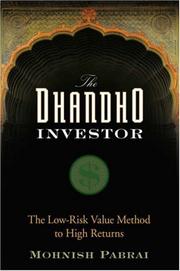
The Dhandho Investor: The Low-Risk Value Method to High Returns
The explicit argument for cloning rather than originating ideas.
Summary
Pabrai, who runs Pabrai Investment Funds and models his approach explicitly on Buffett and Munger, presents a framework built around the Gujarati word dhandho, meaning endeavours that create wealth, and specifically around the practice of Patels who acquired American motels with minimal capital and high asymmetry.
His central formulation is heads I win, tails I do not lose much, meaning investments with limited downside and substantial upside. He builds nine principles: invest in existing businesses rather than start-ups, buy simple businesses in industries with slow change, buy distressed businesses in distressed industries, buy businesses with durable competitive advantages, bet heavily when the odds are overwhelmingly favourable, focus on arbitrage, buy at a large discount to intrinsic value, invest in low-risk high-uncertainty situations, and copy rather than innovate.
The distinction between risk and uncertainty is his most useful contribution. He argues that markets conflate the two, that low-risk high-uncertainty situations are systematically underpriced because uncertainty is uncomfortable, and that these are where returns concentrate. He uses the Kelly formula for position sizing and argues for concentration in ten or fewer positions.
The book is short and the examples, including Stewart Enterprises, Frontline and Level 3 bonds, are worked through with numbers. Pabrai's own subsequent record has been volatile, with a severe drawdown in 2008 and 2009, which readers should weigh. The framework restates Buffett and Munger without adding much theoretically. Its value is the clarity of the asymmetry framing and the explicit treatment of the risk and uncertainty distinction.
Key takeaways 8
- Investments should be structured so that the downside is limited and the upside is large, which Pabrai states as heads I win, tails I do not lose much.
- Risk and uncertainty are different, and low-risk high-uncertainty situations are underpriced because investors avoid discomfort rather than avoid loss.
- Buying into existing businesses rather than creating new ones removes the most expensive category of failure.
- Simple businesses in slow-changing industries can be understood well enough to value, which businesses in fast-changing ones cannot.
- Distressed industries produce prices that reflect the industry's condition rather than the individual company's, which is where the mispricing sits.
- When the odds are overwhelmingly favourable, position sizes should be large, and diversification at that point reduces returns without reducing risk.
- Copying a demonstrated approach beats innovating, and Pabrai applies this to his own method as well as to the businesses he buys.
- Pabrai's own record includes a severe drawdown, which readers should weigh against the low-risk framing of the method.
Who should read it
Value investors who want a compact statement of asymmetric position construction and the risk versus uncertainty distinction.
About Mohnish Pabrai
Founder and Managing Partner, Pabrai Investment Funds
A self-described Buffett-Munger cloner with a long public track record and an unusually open letter archive; The Dhandho Investor gave low-risk/high-uncertainty investing its shorthand.
Where it sits in the reference 7
Who recommended it 3 · 2 direct
Similar books 6
Chosen by shared topics, the entries that hold them, and the people who recommended both.